Indietro
 Bruice 8th EditionCh. 6 - The Reactions of Alkenes • The Stereochemistry of Addition Reactions
Problema 1
Draw the mechanism for the reaction of cyclohexene with HCl
Problema 2a
How many s bond orbitals are available for overlap with the vacant p orbital in the methyl cation?
Problema 2b
Which is more stable: a methyl cation or an ethyl cation? Why?
Problema 3a
How many s bond orbitals are available for overlap with the vacant p orbital in
1. the isobutyl cation?
2. the n-butyl cation?
3. the sec-butyl cation?
Problema 3b
Which of the carbocations in part a is most stable?
1. the isobutyl cation?
2. the n-butyl cation?
3. the sec-butyl cation?
Problema 4a
Rank the following carbocations in each set from most stable to least stable:
a.
Problema 4b
Rank the following carbocations in each set from most stable to least stable:
b.
Problema 5
Is the structure of the transition state in the following reaction coordinate diagrams more similar to the structure of the reactant or to the structure of the product?
<IMAGE>
Problema 6a,b
To which compound is the addition of HBr more highly regioselective?
a.
b.
Problema 7a,b
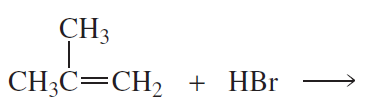
What is the major product obtained from the addition of HBr to each of the following compounds?
a.
b.
Problema 7e,f
What is the major product obtained from the addition of HBr to each of the following compounds?
e.
f.
Problema 8b
What alkene should be used to synthesize each of the following alkyl bromides?
b.
Problema 8c
What alkene should be used to synthesize each of the following alkyl bromides?
c.
Problema 8d
What alkene should be used to synthesize each of the following alkyl bromides?
d.
Problema 9a
The pKa of a protonated alcohol is about -2.5, and the pKa of an alcohol is about 15. Therefore, as long as the pH of the solution is greater than _______ and less than _______, more than 50% of 2-propanol (the product of the reaction on p. 244) will be in its neutral, nonprotonated form.
Problema 10a,b,c
Answer the following questions about the mechanism for the acid-catalyzed hydration of an alkene:
a. How many transition states are there?
b. How many intermediates are there?
c. Which step in the forward direction has the smallest rate constant?
Problema 11a
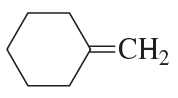
What is the major product obtained from the acid-catalyzed hydration of each of the following alkenes?
a. CH3CH2CH2CH=CH2
Problema 11d
What is the major product obtained from the acid-catalyzed hydration of each of the following alkenes?
d.
Problema 12a(3,4)
What is the major product of each of the following reactions?
3.
4.
Problema 12a(2)
What is the major product of each of the following reactions?
2.
Problema 12a(1)
What is the major product of each of the following reactions?
1.
Problema 13
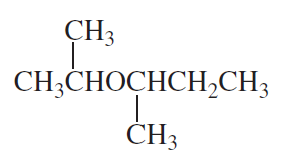
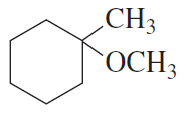
How could the following compound be prepared using an alkene as one of the starting materials?
Problema 14a
How could the following compounds be prepared using an alkene as one of the starting materials?
a.
Problema 14b
How could the following compounds be prepared using an alkene as one of the starting materials?
b.
Problema 14c
How could the following compounds be prepared using an alkene as one of the starting materials?
c.
Problema 14d
How could the following compounds be prepared using an alkene as one of the starting materials?
d.
Problema 14e
How could the following compounds be prepared using an alkene as one of the starting materials?
e.
Problema 15
Propose a mechanism for the following reaction (remember to use curved arrows to show the movement of electrons from the nucleophile to the electrophile):
Problema 16a
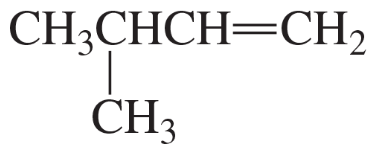
Which of the following carbocations would you expect to rearrange?
Problema 17a
What is the major product obtained from the reaction of HBr with each of the following?
a.