Indietro
 Bruice 8th EditionCh. 9 - Substitution and Elimination Reactions of Alkyl Halides
Problema 92c
Starting with an alkyl halide, how could the following compounds be prepared?
c. butylmethylamine
Problema 93a
Indicate which species in each pair gives a higher substitution-product-to-elimination-product ratio when it reacts with isopropyl bromide:
a. ethoxide ion or tert-butoxide ion
Problema 93c
Indicate which species in each pair gives a higher substitution-product-to-elimination-product ratio when it reacts with isopropyl bromide:
c. Cl− or Br−
Problema 94
Rank the following from most reactive to least reactive in an E2 reaction:
Problema 95
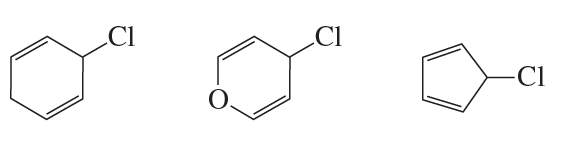
Rank the following from most reactive to least reactive in an SN1 reaction:
Problema 96a
For each of the following alkyl halides, indicate the stereoisomer that would be obtained in greatest yield in an E2 reaction.
a. 3-bromo-2,2,3-trimethylpentane
Problema 96b
For each of the following alkyl halides, indicate the stereoisomer that would be obtained in greatest yield in an E2 reaction.
b. 4-bromo-2,2,3,3-tetramethylpentane
Problema 96c,d
For each of the following alkyl halides, indicate the stereoisomer that would be obtained in greatest yield in an E2 reaction.
c. 3-bromo-2,3-dimethylpentane
d. 3-bromo-3,4-dimethylhexane
Problema 96d
For each of the following alkyl halides, indicate the stereoisomer that would be obtained in greatest yield in an E2 reaction.
d. 3-bromo-3,4-dimethylhexane
Problema 97
Which of following ethers cannot be made by a Williamson ether synthesis?
Problema 98
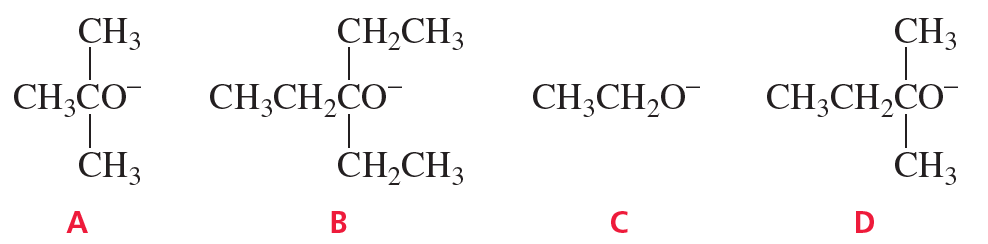
When 2-bromo-2,3-dimethylbutane reacts with a strong base, two alkenes (2,3-dimethyl-1-butene and 2,3-dimethyl-2-butene) are formed.
a. Which of the bases (A, B, C, or D) would form the highest percentage of the 1-alkene?
b. Which would give the highest percentage of the 2-alkene?
Problema 99a,b
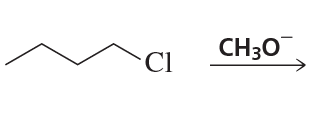
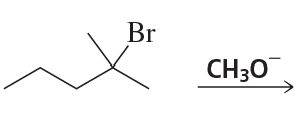
What are the products of the following reactions?
a.
b.
Problema 99e
What are the products of the following reactions?
e.
Problema 99f
What are the products of the following reactions?
f.
Problema 99g,h
What are the products of the following reactions?
g.
h.
Problema 100a,b
a. Draw the structures of the products obtained from the reaction of each enantiomer of cis-1-chloro-2-isopropylcyclopentane with sodium methoxide in methanol.
b. Are all the products optically active?
Problema 101
When the following compound undergoes solvolysis in ethanol, three products are obtained. Propose a mechanism to account for the formation of these products.
Problema 102
cis-1-Bromo-4-tert-butylcyclohexane and trans-1-bromo-4-tert-butylcyclohexane both react with sodium ethoxide in ethanol to form 4-tert-butylcyclohexene. Explain why the cis isomer reacts much more rapidly than the trans isomer.
Problema 103a,b
Draw the substitution and elimination products.
a.
b.
Problema 104
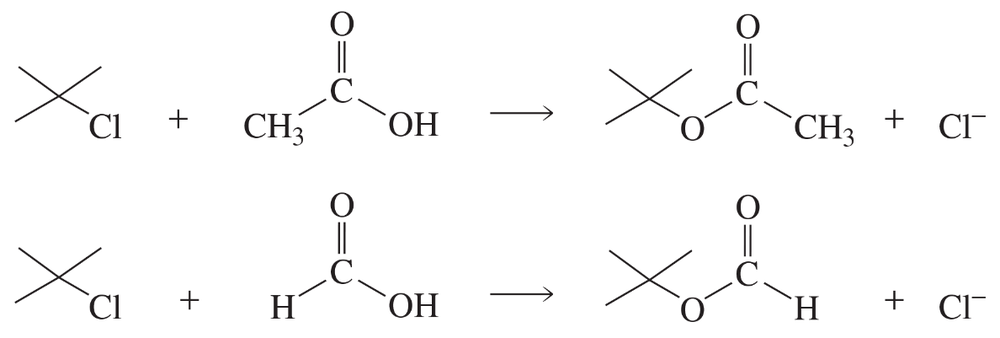
tert-Butyl chloride undergoes solvolysis in both acetic acid and formic acid. Solvolysis occurs 5000 times faster in one of these two solvents than in the other. In which solvent is solvolysis faster? Explain your answer. (Hint: Formic acid is more polar than acetic acid.)
Problema 105
What substitution products are obtained when each of the following compounds is added to a solution of sodium acetate in acetic acid?
a. 2-chloro-2-methyl-3-hexene
b. 3-bromo-1-methylcyclohexene
Problema 106a
Show how each of the following compounds can be synthesized from the given starting materials:
a. CH3CH2CH2Br→CH3CH2CH2CH2CH3
Problema 106b
Show how each of the following compounds can be synthesized from the given starting materials:
b.
Problema 106c
Show how each of the following compounds can be synthesized from the given starting materials:
c.
Problema 106d
Show how each of the following compounds can be synthesized from the given starting materials:
d.
Problema 107
In which solvent—ethanol or diethyl ether—would the equilibrium for the following SN2 reaction lie farther to the right?
Problema 108a
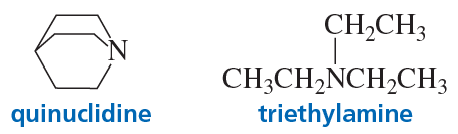
The rate of the reaction of methyl iodide with quinuclidine was measured in nitrobenzene, and then the rate of the reaction of methyl iodide with triethylamine was measured in the same solvent. The concentration of the reagents was the same in both experiments.
a.Which reaction had the larger rate constant?
Problema 108b
The rate of the reaction of methyl iodide with quinuclidine was measured in nitrobenzene, and then the rate of the reaction of methyl iodide with triethylamine was measured in the same solvent. The concentration of the reagents was the same in both experiments.
b. The same experiment was done using isopropyl iodide instead of methyl iodide. Which reaction had the larger rate constant?
Problema 108c
The rate of the reaction of methyl iodide with quinuclidine was measured in nitrobenzene, and then the rate of the reaction of methyl iodide with triethylamine was measured in the same solvent. The concentration of the reagents was the same in both experiments.
c. Which alkyl halide has the larger kquinuclidine/ktriethylamine ratio?
Problema 109
Two bromoethers are obtained from the reaction of the following alkyl dihalide with methanol. Draw the structures of the ethers.