Ch. 9 - Substitution and Elimination Reactions of Alkyl Halides
Bruice - Organic Chemistry 8th Edition
Bruice8th EditionOrganic ChemistryISBN: 9780135213711Non è quello che usi tu?Cambia libro di testo
Capitolo 9, Problema 107

In which solvent—ethanol or diethyl ether—would the equilibrium for the following SN2 reaction lie farther to the right?

Guida verificata passo dopo passo
1
Step 1: Understand the reaction type. This is an SN2 reaction, which involves a single-step mechanism where the nucleophile attacks the electrophile, displacing the leaving group. The reaction rate and equilibrium are influenced by the solvent used.
Step 2: Analyze the solvents. Ethanol is a polar protic solvent, meaning it can form hydrogen bonds and stabilize ions like Br⁻ through solvation. Diethyl ether, on the other hand, is a polar aprotic solvent, which does not form hydrogen bonds but can stabilize cations through dipole interactions.
Step 3: Consider the role of the solvent in stabilizing the products. In this reaction, the products include CH₃SCH₃⁺ (a positively charged species) and Br⁻ (a negatively charged ion). Ethanol, being polar protic, will stabilize Br⁻ more effectively than diethyl ether, potentially shifting the equilibrium farther to the right.
Step 4: Evaluate the nucleophile and electrophile. The nucleophile (CH₃SCH₃) and electrophile (CH₃Br) are less affected by the solvent compared to the stabilization of the ionic products. Therefore, the solvent's ability to stabilize the ions is the key factor in determining the equilibrium position.
Step 5: Conclude the solvent's effect on equilibrium. Since ethanol can stabilize the ionic products better than diethyl ether, the equilibrium for this SN2 reaction would lie farther to the right in ethanol compared to diethyl ether.

Risposta video verificata per un problema simile:

Questa soluzione video è stata consigliata dai nostri tutor come utile per risolvere questo problema.
Durata del video:
6m

Concetti chiave

Ecco i concetti essenziali che devi comprendere per rispondere correttamente alla domanda.

SN2 Reaction Mechanism

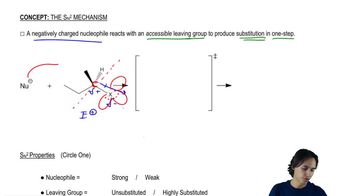
The SN2 (substitution nucleophilic bimolecular) reaction is a type of nucleophilic substitution where the nucleophile attacks the electrophile simultaneously as the leaving group departs. This concerted mechanism results in a single transition state and is characterized by a second-order rate law, meaning the reaction rate depends on the concentration of both the nucleophile and the substrate.
Video consigliato:
08:33
Drawing the SN2 Mechanism

Solvent Effects on Reaction Equilibrium

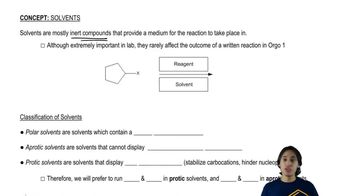
The choice of solvent can significantly influence the equilibrium position of a reaction. Polar protic solvents, like ethanol, can stabilize ions through solvation, while polar aprotic solvents, like diethyl ether, can enhance nucleophilicity by not solvating the nucleophile as effectively. This difference can shift the equilibrium towards products or reactants depending on the solvent used.
Video consigliato:
02:26
General format of reactions and how to interpret solvents.

Nucleophilicity and Solvent Polarity

Nucleophilicity refers to the ability of a nucleophile to donate an electron pair to an electrophile. In polar protic solvents, nucleophiles are often less nucleophilic due to solvation effects, while in polar aprotic solvents, nucleophiles remain more reactive. Understanding how solvent polarity affects nucleophilicity is crucial for predicting the direction of equilibrium in SN2 reactions.
Video consigliato:
01:16
Identification of polarity in solvents
Pratica correlata
Domanda del libro di testo

Show how each of the following compounds can be synthesized from the given starting materials:

b.

700
views

Domanda del libro di testo

The rate of the reaction of methyl iodide with quinuclidine was measured in nitrobenzene, and then the rate of the reaction of methyl iodide with ­triethylamine was measured in the same solvent. The concentration of the reagents was the same in both experiments.

b. The same experiment was done using isopropyl iodide instead of methyl iodide. Which reaction had the larger rate constant?

1286
views
Domanda del libro di testo

The rate of the reaction of methyl iodide with quinuclidine was measured in nitrobenzene, and then the rate of the reaction of methyl iodide with ­triethylamine was measured in the same solvent. The concentration of the reagents was the same in both experiments.

c. Which alkyl halide has the larger kquinuclidine/ktriethylamine ratio?

1486
views
Domanda del libro di testo

Show how each of the following compounds can be synthesized from the given starting materials:

d.

752
views
Domanda del libro di testo

Show how each of the following compounds can be synthesized from the given starting materials:

c.

1158
views
Domanda del libro di testo

The rate of the reaction of methyl iodide with quinuclidine was measured in nitrobenzene, and then the rate of the reaction of methyl iodide with ­triethylamine was measured in the same solvent. The concentration of the reagents was the same in both experiments.

a.Which reaction had the larger rate constant?

696
views