Indietro
 Bruice 8th EditionCh. 9 - Substitution and Elimination Reactions of Alkyl Halides
Problema 110a,b
Draw the substitution products for each of the following SN2 reactions. If the products can exist as stereoisomers, show which stereoisomers are formed:
a. (3S,4S)-3-bromo-4-methylhexane + CH3O-
b. (3S,4R)-3-bromo-4-methylhexane + CH3O-
Problema 110c,d
Draw the substitution products for each of the following SN2 reactions. If the products can exist as stereoisomers, show which stereoisomers are formed:
c. (3R,4R)-3-bromo-4-methylhexane + CH3O-
d. (3R,4S)-3-bromo-4-methylhexane + CH3O-
Problema 111a,b
Draw the elimination products for each of the following E2 reactions; if the products can exist as stereoisomers, indicate which stereoisomers are obtained.
a. (2S,3S)-2-chloro-3-methylpentane + high concentration of CH3O−
b. (2S,3R)-2-chloro-3-methylpentane + high concentration of CH3O−
Problema 111c
Draw the elimination products for each of the following E2 reactions; if the products can exist as stereoisomers, indicate which stereoisomers are obtained.
c. (2R,3S)-2-chloro-3-methylpentane + high concentration of CH3O-
Problema 111d
Draw the elimination products for each of the following E2 reactions; if the products can exist as stereoisomers, indicate which stereoisomers are obtained.
d. (2R,3R)-2-chloro-3-methylpentane + high concentration of CH3O-
Problema 111e
Draw the elimination products for each of the following E2 reactions; if the products can exist as stereoisomers, indicate which stereoisomers are obtained.
e. 3-chloro-3-ethyl-2,2-dimethylpentane + high concentration of CH3CH2O-
Problema 112a
Draw the major elimination product that would be obtained from each of the following reactants with a strong base and with a weak base:
a.
Problema 114
Explain why the rate of the reaction of 1-bromo-2-butene with ethanol is increased if silver nitrate is added to the reaction mixture.
Problema 115a
Draw the products of each of the following SN2/E2 reactions. If the products can exist as stereoisomers, show which stereoisomers are formed.
a. (3S,4S)-3-bromo-4-methylhexane + CH3O−
Problema 115b
Draw the products of each of the following SN2/E2 reactions. If the products can exist as stereoisomers, show which stereoisomers are formed.
b. (3R,4R)-3-bromo-4-methylhexane + CH3O−
Problema 115c
Draw the products of each of the following SN2/E2 reactions. If the products can exist as stereoisomers, show which stereoisomers are formed.
c. (3S,4R)-3-bromo-4-methylhexane + CH3O−
Problema 116
Two elimination products are obtained from the following E2 reaction:
a. What are the elimination products?
b. Which is formed in greater yield?
Problema 117
Draw the structures of the products obtained from the following reaction:
Problema 118b
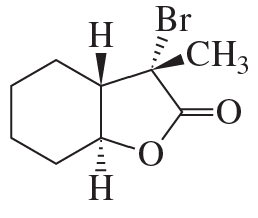
How could you prepare the following compounds from the given starting materials?
b.
Problema 119a
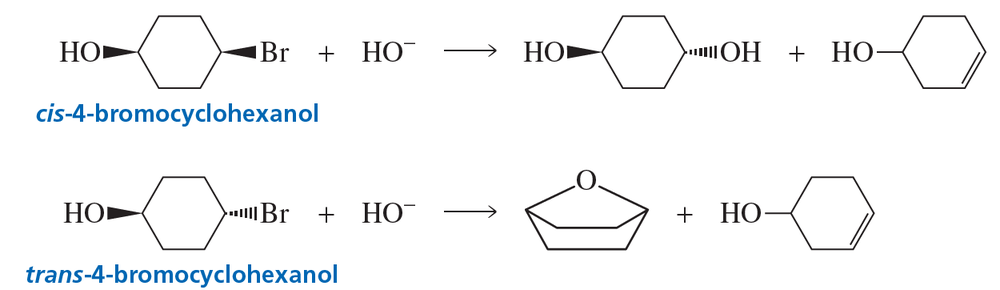
cis-4-Bromocyclohexanol and trans-4-bromocyclohexanol form the same elimination product but a different substitution product when they react with HO−.
a. Why do they form the same elimination product?
Problema 119b
cis-4-Bromocyclohexanol and trans-4-bromocyclohexanol form the same elimination product but a different substitution product when they react with HO−.
b. Explain, by showing the mechanisms, why different substitution products are obtained.
Problema 119c
cis-4-Bromocyclohexanol and trans-4-bromocyclohexanol form the same elimination product but a different substitution product when they react with HO−.
c. How many stereoisomers does each of the elimination and substitution reactions form?
Problema 120a(1)
Draw the product of each of the following reactions:
1.
Problema 120a(2)
Draw the product of each of the following reactions:
2.
Problema 120b
Give two sets of reactants (each set including an alkyl halide and a nucleophile) that could be used to synthesize the following alkyne:
CH3CH2C≡CCH2CH2CH2CH3
Problema 120c
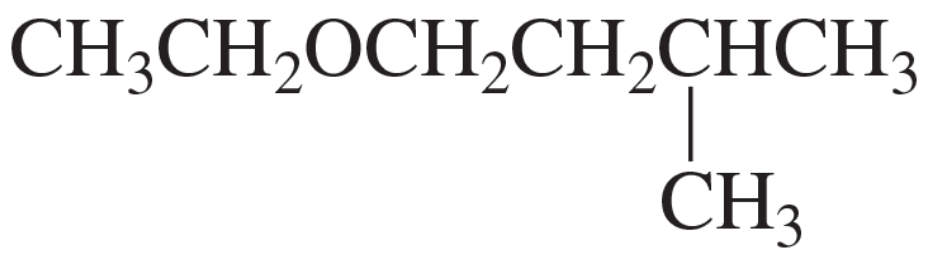
Give two sets of reactants (each set including an alkyl halide and a nucleophile) that could be used to synthesize the following ether:
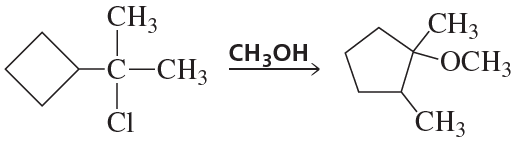
Problema 121
Propose a mechanism for the following reaction:
Problema 122
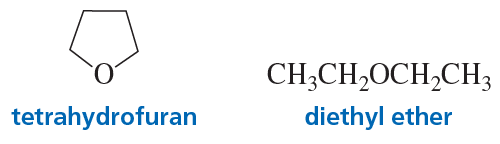
Explain why tetrahydrofuran can solvate a positively charged species better than diethyl ether can.
Problema 123
The reaction of an alkyl chloride with potassium iodide is generally carried out in acetone to maximize the amount of alkyl iodide that is formed. Why does the solvent increase the yield of alkyl iodide? (Hint: Potassium iodide is soluble in acetone, but potassium chloride is not.)
Problema 124a
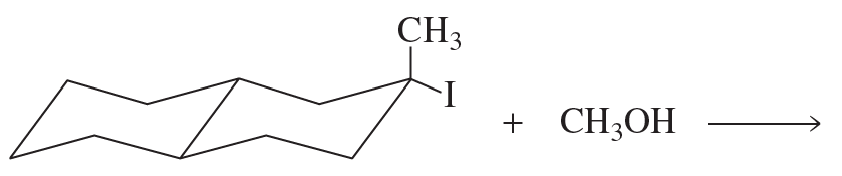
Propose a mechanism for the following reaction.
Problema 125
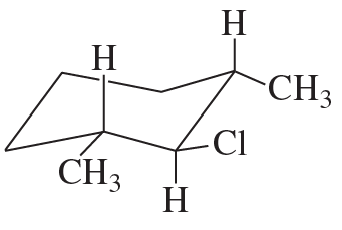
What products are formed when the following stereoisomer of 2-chloro-1,3-dimethylcyclohexane reacts with methoxide ion?
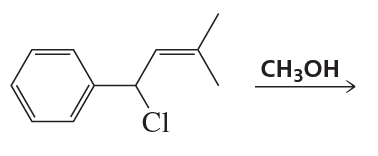
Problema 126
Predict the product for the following reaction and write a mechanism to explain how it is formed.
Problema 127a
For each of the following compounds, draw the product that forms in an E2 reaction and indicate its configuration:
a. (1S,2S)-1-bromo-1,2-diphenylpropane
Problema 127b
For each of the following compounds, draw the product that forms in an E2 reaction and indicate its configuration:
b. (1S,2R)-1-bromo-1,2-diphenylpropane
Problema 129
When equivalent amounts of methyl bromide and sodium iodide are dissolved in methanol, the concentration of iodide ion quickly decreases and then slowly returns to its original concentration. Account for this observation.