Ch. 11 - Properties and Synthesis of Alkyl Halides: Radical Reactions
Mullins - Organic Chemistry: A Learner Centered Approach 1st Edition
Mullins1st EditionOrganic Chemistry: A Learner Centered ApproachISBN: 9780137566471Non è quello che usi tu?Cambia libro di testo
Capitolo 10, Problema 16d

Based on the stability of the radicals produced, predict which bond in each pair would have the higher bond-dissociation energy.
(d)

Guida verificata passo dopo passo
1
Identify the two molecules in the image: one is a bromocyclohexane and the other is an allylic bromide.
Understand that bond-dissociation energy is related to the stability of the radicals formed when the bond is broken. More stable radicals result in lower bond-dissociation energy.
Consider the stability of the radicals formed: breaking the C-Br bond in bromocyclohexane forms a cyclohexyl radical, while breaking the C-Br bond in the allylic bromide forms an allylic radical.
Recall that allylic radicals are stabilized by resonance, which allows the unpaired electron to be delocalized over the π system, increasing stability.
Conclude that the allylic radical is more stable than the cyclohexyl radical due to resonance stabilization, suggesting that the C-Br bond in bromocyclohexane has a higher bond-dissociation energy.

Risposta video verificata per un problema simile:

Questa soluzione video è stata consigliata dai nostri tutor come utile per risolvere questo problema.

Concetti chiave

Ecco i concetti essenziali che devi comprendere per rispondere correttamente alla domanda.

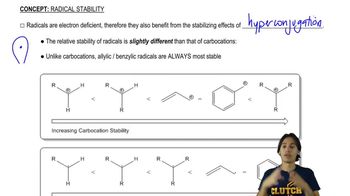
Radical Stability

Radical stability is crucial in determining bond-dissociation energy. More stable radicals form from weaker bonds, as they require less energy to break. Stability is influenced by factors like hyperconjugation and resonance. In the given image, the radical formed from the allylic bromine bond benefits from resonance stabilization, making it more stable than the cyclohexyl radical.
Video consigliato:
03:43
The radical stability trend.

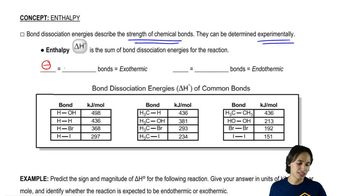
Bond-Dissociation Energy

Bond-dissociation energy is the energy required to break a bond homolytically, forming radicals. It is higher for bonds that produce less stable radicals upon dissociation. In the image, the cyclohexyl bromine bond likely has a higher bond-dissociation energy because the resulting radical is less stable compared to the allylic radical, which is resonance-stabilized.
Video consigliato:
04:09
How to calculate enthalpy using bond dissociation energies.

Resonance Stabilization

Resonance stabilization occurs when a radical can delocalize its unpaired electron over multiple atoms, increasing stability. This is common in allylic positions, where the radical can be spread across a conjugated system. In the image, the allylic radical formed from the second structure is resonance-stabilized, making it more stable than the cyclohexyl radical, which lacks such delocalization.
Video consigliato:
03:43
The radical stability trend.