Ch. 13 - Alcohols, Ethers and Related Compounds: Substitution and Elimination
Mullins - Organic Chemistry: A Learner Centered Approach 1st Edition
Mullins1st EditionOrganic Chemistry: A Learner Centered ApproachISBN: 9780137566471Non è quello che usi tu?Cambia libro di testo
Capitolo 12, Problema 112

In Chapter 12, we learned that crown ethers were used to increase the rate of SN2 reactions (Assessment 12.80). Suggest a synthesis of 15-crown-5 using the reactions learned here in Chapter 13.

Guida verificata passo dopo passo
1
Identify the structure of 15-crown-5, which consists of a cyclic ether with five ethylene oxide units. This means it has five oxygen atoms and a total of 15 atoms in the ring.
To synthesize 15-crown-5, start with ethylene glycol as the base unit. Ethylene glycol can be converted into ethylene oxide, which is a key building block for crown ethers.
Use a Williamson ether synthesis to link the ethylene oxide units. This involves deprotonating the hydroxyl group of ethylene glycol to form an alkoxide ion, which can then attack an ethylene oxide molecule to form an ether linkage.
Repeat the ether formation process to build the chain of ethylene oxide units. This step is crucial to form the linear precursor that will eventually be cyclized into the crown ether.
Finally, cyclize the linear polyether chain to form the cyclic structure of 15-crown-5. This can be achieved by using a suitable base to deprotonate the terminal hydroxyl group, allowing it to attack the other end of the chain and close the ring.

Risposta video verificata per un problema simile:

Questa soluzione video è stata consigliata dai nostri tutor come utile per risolvere questo problema.
Durata del video:
4m

Concetti chiave

Ecco i concetti essenziali che devi comprendere per rispondere correttamente alla domanda.

Crown Ethers

Crown ethers are cyclic compounds that contain multiple ether groups, which can selectively bind cations due to their unique size and shape. The number in their name indicates the number of atoms in the ring, and their ability to form complexes with metal ions enhances solubility and reactivity in organic reactions, particularly in S_N2 mechanisms.
Video consigliato:
04:22
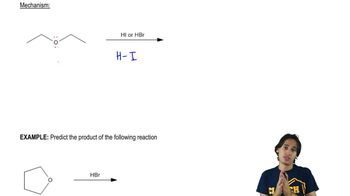
How to predict the products of Ether Cleavage.

S_N2 Reactions

S_N2 (substitution nucleophilic bimolecular) reactions involve a nucleophile attacking an electrophile, resulting in the simultaneous displacement of a leaving group. This mechanism is characterized by a single concerted step, where the reaction rate depends on the concentration of both the nucleophile and the substrate, making it sensitive to steric hindrance.
Video consigliato:
05:09
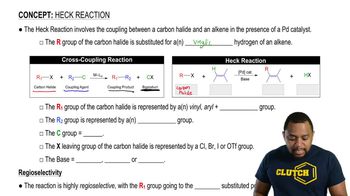
Heck Reaction

Synthetic Pathways

Synthetic pathways refer to the series of chemical reactions and transformations used to construct a target molecule from simpler precursors. Understanding the functional groups, reaction conditions, and mechanisms involved is crucial for designing efficient syntheses, such as that of 15-crown-5, which may involve alkylation and etherification reactions.
Video consigliato:
Percorso guidato
2:13
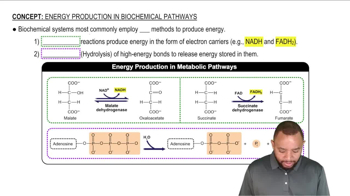
Energy Production In Biochemical Pathways Concept 1
Pratica correlata
Domanda del libro di testo

Benzyl ethers make excellent protecting groups according to the general scheme shown here.

(a) How would you protect the 1° alcohol as a benzyl ether in the first step?

854
views

Domanda del libro di testo

Thiols are prone to dimerize through the formation of a disulfide bond in a reaction that stylists use to induce permanent curls in hair. What type of reagent would you use to effect this transformation?

1035
views
Domanda del libro di testo

Triphenylphosphine and iodine can be used to convert alcohols to iodoalkanes. Suggest a mechanism for this reaction. [Triphenylphosphine first acts as a nucleophile in this reaction.]

1480
views
Domanda del libro di testo

A chemist attempted the reaction below, one we introduce in Chapter 17, expecting the reaction between a strong nucleophile and a ketone in water to give an alkoxide product.

(a) Why did the reaction fail?

(b) How could the reaction conditions be changed to give a successful reaction?

980
views
Domanda del libro di testo

Another method for converting alcohols to chloroalkanes makes use of chlorotrimethylsilane (TMSCl) and DMSO. Suggest a mechanism for this reaction to form (a) a 1° chloroalkane and (b) a 3° chloroalkane. [The reaction begins by the reaction of DMSO and TMSCl and is analogous to the Swern oxidation.]


851
views
Domanda del libro di testo

We explain in Chapter 24 that bisphenols can be oxidized to quinones.

(a) Calculate the oxidation numbers of C1 and C₂ in going from reactant to product.

(b) Provide a mechanism for this transformation. [The reaction begins like the alcohol oxidations of Section 13.9.]


1024
views