Ch. 13 - Alcohols, Ethers and Related Compounds: Substitution and Elimination
Mullins - Organic Chemistry: A Learner Centered Approach 1st Edition
Mullins1st EditionOrganic Chemistry: A Learner Centered ApproachISBN: 9780137566471Non è quello che usi tu?Cambia libro di testo
Capitolo 12, Problema 115a

Benzyl ethers make excellent protecting groups according to the general scheme shown here.
(a) How would you protect the 1° alcohol as a benzyl ether in the first step?
Chemical reaction scheme illustrating the protection of a primary alcohol as a benzyl ether, with numbered steps and a question mark.

Guida verificata passo dopo passo
1
Identify the primary alcohol in the given structure. The primary alcohol is the hydroxyl group (OH) attached to the terminal carbon atom.
To protect the primary alcohol as a benzyl ether, you need to perform a reaction with benzyl chloride (C6H5CH2Cl) in the presence of a base. The base is typically a strong base like sodium hydride (NaH) or potassium carbonate (K2CO3).
The base deprotonates the alcohol, forming an alkoxide ion. This alkoxide ion is a good nucleophile and will attack the benzyl chloride, resulting in the formation of a benzyl ether.
The reaction can be represented as: \( \text{ROH} + \text{C}_6\text{H}_5\text{CH}_2\text{Cl} \xrightarrow{\text{Base}} \text{ROCH}_2\text{C}_6\text{H}_5} \), where ROH is the primary alcohol and ROCH2C6H5 is the benzyl ether.
Ensure that the reaction conditions are anhydrous to prevent any side reactions with water, which could interfere with the formation of the benzyl ether.

Risposta video verificata per un problema simile:

Questa soluzione video è stata consigliata dai nostri tutor come utile per risolvere questo problema.
Durata del video:
5m

Concetti chiave

Ecco i concetti essenziali che devi comprendere per rispondere correttamente alla domanda.

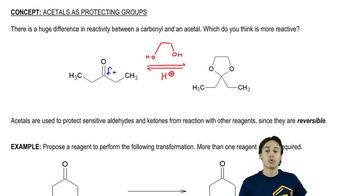
Protecting Groups

Protecting groups are chemical groups used to temporarily mask a functional group to prevent it from reacting under certain conditions. In organic synthesis, they are crucial for selective reactions, allowing chemists to modify specific parts of a molecule without affecting others. Benzyl ethers are commonly used as protecting groups for alcohols due to their stability and ease of removal under reductive conditions.
Video consigliato:
02:44
Protecting Groups

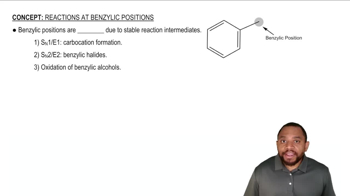
Formation of Benzyl Ethers

The formation of benzyl ethers typically involves the reaction of an alcohol with benzyl chloride in the presence of a base, such as sodium or potassium carbonate. This reaction proceeds via an SN2 mechanism, where the alcohol acts as a nucleophile, displacing the chloride ion from benzyl chloride. This process effectively protects the alcohol group by converting it into a benzyl ether.
Video consigliato:
Percorso guidato
1:01
Reactions at Benzylic Positions Concept 1

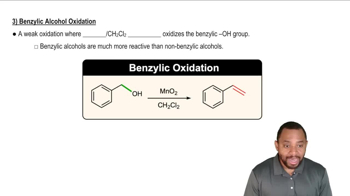
Deprotection of Benzyl Ethers

Deprotection of benzyl ethers is commonly achieved through hydrogenolysis, which involves the use of hydrogen gas and a palladium catalyst. This reaction cleaves the ether bond, regenerating the original alcohol and releasing toluene as a byproduct. The mild conditions of hydrogenolysis make it a preferred method for deprotecting benzyl ethers without affecting other sensitive functional groups in the molecule.
Video consigliato:
Percorso guidato
0:58
Reactions at Benzylic Positions Concept 4