Ch. 13 - Alcohols, Ethers and Related Compounds: Substitution and Elimination
Mullins - Organic Chemistry: A Learner Centered Approach 1st Edition
Mullins1st EditionOrganic Chemistry: A Learner Centered ApproachISBN: 9780137566471Non è quello che usi tu?Cambia libro di testo
Capitolo 12, Problema 114

A chemist attempted the reaction below, one we introduce in Chapter 17, expecting the reaction between a strong nucleophile and a ketone in water to give an alkoxide product.
(a) Why did the reaction fail?
(b) How could the reaction conditions be changed to give a successful reaction?
Chemical reaction diagram showing a Grignard reagent, a ketone, and water, with a red cross indicating the product is not formed.

Guida verificata passo dopo passo
1
Identify the reactants and the expected product in the reaction. The reactants are a Grignard reagent (isopropylmagnesium bromide) and a ketone (acetone), and the expected product is an alkoxide.
Understand the role of the Grignard reagent. Grignard reagents are strong nucleophiles and bases, which typically react with carbonyl compounds to form alcohols after hydrolysis.
Analyze why the reaction failed. The presence of water in the reaction mixture is problematic because Grignard reagents react with water to form alkanes, thus deactivating the Grignard reagent before it can react with the ketone.
Consider how to modify the reaction conditions. To successfully carry out the reaction, the Grignard reagent should be reacted with the ketone in an anhydrous (water-free) environment to prevent its deactivation.
Propose a solution. Use an inert, dry solvent such as diethyl ether or tetrahydrofuran (THF) to perform the reaction, and ensure that all glassware and reagents are dry to prevent any moisture from interfering with the reaction.

Risposta video verificata per un problema simile:

Questa soluzione video è stata consigliata dai nostri tutor come utile per risolvere questo problema.

Concetti chiave

Ecco i concetti essenziali che devi comprendere per rispondere correttamente alla domanda.

Nucleophilicity

Nucleophilicity refers to the ability of a nucleophile to donate an electron pair to an electrophile, facilitating a chemical reaction. Strong nucleophiles, such as alkoxides or amines, are more reactive and can effectively attack electrophilic centers like carbonyls in ketones. Understanding the strength and nature of the nucleophile is crucial in predicting the outcome of reactions involving ketones.
Video consigliato:
08:27
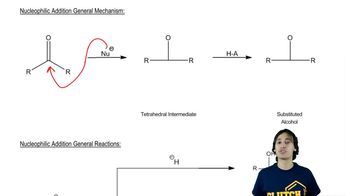
Nucleophilic Addition

Ketone Reactivity

Ketones are characterized by a carbonyl group (C=O) flanked by two carbon atoms. Their reactivity is influenced by the electrophilic nature of the carbonyl carbon, which can be attacked by nucleophiles. However, the presence of steric hindrance or electronic effects from substituents can affect the reaction's feasibility, making it essential to consider these factors when predicting reaction outcomes.
Video consigliato:
02:27
Name the ketone

Reaction Conditions

Reaction conditions, including solvent, temperature, and concentration, play a critical role in determining the success of a chemical reaction. In the case of a nucleophilic attack on a ketone, using a polar protic solvent like water can stabilize the nucleophile and the transition state, but may also lead to unwanted side reactions. Adjusting these conditions, such as using a non-protic solvent or altering the temperature, can enhance the likelihood of a successful reaction.
Video consigliato:
Percorso guidato
1:18
EAS Reactions of Pyridine Example 1