Ch. 13 - Alcohols, Ethers and Related Compounds: Substitution and Elimination
Mullins - Organic Chemistry: A Learner Centered Approach 1st Edition
Mullins1st EditionOrganic Chemistry: A Learner Centered ApproachISBN: 9780137566471Non è quello che usi tu?Cambia libro di testo
Capitolo 12, Problema 28b

Predict the product of the following reactions.
(b)

Guida verificata passo dopo passo
1
Step 1: Analyze the reactant structure. The molecule contains a secondary alcohol group (-OH) attached to a chiral carbon. The reaction involves HCl, which suggests an acid-catalyzed substitution reaction.
Step 2: Understand the mechanism. In the presence of HCl, the hydroxyl group (-OH) will be protonated to form water (H2O), a good leaving group. This step facilitates the formation of a carbocation intermediate.
Step 3: Consider carbocation stability. The secondary carbocation formed after the departure of water is relatively stable. No rearrangement is expected since the secondary carbocation is not adjacent to a more stable tertiary position.
Step 4: Nucleophilic attack. The chloride ion (Cl⁻) from HCl will act as a nucleophile and attack the carbocation, leading to the formation of a new C-Cl bond.
Step 5: Predict stereochemistry. Since the reaction proceeds via a carbocation intermediate, the product will likely be a racemic mixture due to the planar nature of the carbocation, allowing attack from either side.

Risposta video verificata per un problema simile:

Questa soluzione video è stata consigliata dai nostri tutor come utile per risolvere questo problema.
Durata del video:
1m

Concetti chiave

Ecco i concetti essenziali che devi comprendere per rispondere correttamente alla domanda.

Reaction Mechanisms

Understanding reaction mechanisms is crucial in organic chemistry as they describe the step-by-step process by which reactants transform into products. This includes identifying intermediates, transition states, and the movement of electrons. Familiarity with mechanisms helps predict the outcome of reactions and the stability of products formed.
Video consigliato:
02:16
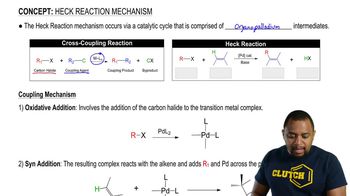
Heck Reaction Mechanism

Functional Groups

Functional groups are specific groups of atoms within molecules that are responsible for the characteristic chemical reactions of those molecules. Recognizing functional groups allows chemists to predict reactivity patterns and the types of reactions that can occur, which is essential for predicting products in organic reactions.
Video consigliato:
02:36
Identifying Functional Groups

Stereochemistry

Stereochemistry involves the study of the spatial arrangement of atoms in molecules and how this affects their chemical behavior. It is important for predicting the products of reactions, especially in cases where chirality or geometric isomerism is involved, as different stereoisomers can lead to different products with distinct properties.
Video consigliato:
Percorso guidato
1:38
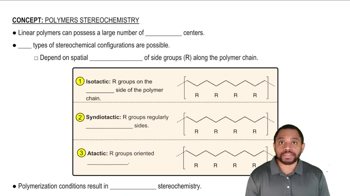
Polymer Stereochemistry Concept 1