Ch. 13 - Alcohols, Ethers and Related Compounds: Substitution and Elimination
Mullins - Organic Chemistry: A Learner Centered Approach 1st Edition
Mullins1st EditionOrganic Chemistry: A Learner Centered ApproachISBN: 9780137566471Non è quello che usi tu?Cambia libro di testo
Capitolo 12, Problema 15a

Suggest a reagent and a reactant that could be combined to make each of the following alcohols.
(a)

Guida verificata passo dopo passo
1
Identify the functional groups in the starting material and the product. The starting material has a chlorine atom (Cl) attached to a secondary carbon, indicating it is a secondary alkyl chloride. The product has an alcohol group (OH) in place of the chlorine.
Recognize that the transformation involves replacing the chlorine atom with a hydroxyl group. This is a typical nucleophilic substitution reaction.
Consider common reagents for nucleophilic substitution reactions. A good choice for converting an alkyl chloride to an alcohol is using a hydroxide ion (OH⁻) as the nucleophile.
Select a suitable source of hydroxide ions. Sodium hydroxide (NaOH) or potassium hydroxide (KOH) are common reagents that provide OH⁻ ions in solution.
Propose the reaction conditions. The reaction can be carried out in an aqueous or alcoholic solution, often with heating to facilitate the substitution process.

Risposta video verificata per un problema simile:

Questa soluzione video è stata consigliata dai nostri tutor come utile per risolvere questo problema.

Concetti chiave

Ecco i concetti essenziali che devi comprendere per rispondere correttamente alla domanda.

Alcohol Functional Group

Alcohols are organic compounds characterized by the presence of one or more hydroxyl (-OH) groups attached to a carbon atom. Understanding the structure and properties of alcohols is essential for identifying suitable reagents and reactants for their synthesis. The position of the hydroxyl group can significantly influence the reactivity and properties of the alcohol.
Video consigliato:
02:36
Identifying Functional Groups

Reagents in Organic Synthesis

Reagents are substances that are added to a reaction to cause a chemical change. In the context of synthesizing alcohols, common reagents include reducing agents like lithium aluminum hydride (LiAlH4) or borane (BH3), which can convert carbonyl compounds (like aldehydes or ketones) into alcohols. Knowing the appropriate reagents for specific transformations is crucial for successful synthesis.
Video consigliato:
Percorso guidato
1:16
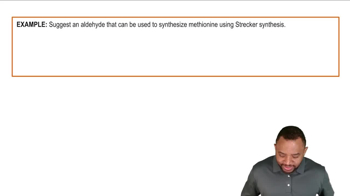
Synthesis of Amino Acids: Strecker Synthesis Example 1

Reaction Mechanisms

Understanding reaction mechanisms is vital for predicting the products of chemical reactions. Mechanisms describe the step-by-step process by which reactants are converted into products, including the formation and breaking of bonds. Familiarity with mechanisms helps in selecting the right reactants and reagents to achieve the desired alcohol synthesis efficiently.
Video consigliato:
02:16
Heck Reaction Mechanism