Ch. 17 - Carbonyl Addition Reactions: Aldehydes and Ketones
Mullins - Organic Chemistry: A Learner Centered Approach 1st Edition
Mullins1st EditionOrganic Chemistry: A Learner Centered ApproachISBN: 9780137566471Non è quello che usi tu?Cambia libro di testo
Capitolo 16, Problema 12b

Classify the following nucleophiles as strong, weak, or intermediate. Would you expect each to add to a carbonyl directly or wait for a carbocation to form?
b) Chemical structure of a carbonyl group with a hydroxyl group attached, illustrating nucleophile classification.

Guida verificata passo dopo passo
1
Step 1: Analyze the structure of the nucleophile provided in the image. The molecule shown is a carboxylic acid, which contains a carbonyl group (C=O) and a hydroxyl group (-OH) attached to the same carbon.
Step 2: Evaluate the nucleophilicity of the molecule. Carboxylic acids are generally weak nucleophiles because the oxygen atoms are involved in resonance stabilization, reducing their availability to donate electrons.
Step 3: Consider the reactivity of the nucleophile with a carbonyl group. Weak nucleophiles typically do not add directly to a carbonyl group unless the carbonyl is activated (e.g., by protonation or the formation of a carbocation).
Step 4: Determine whether the nucleophile would wait for a carbocation to form. In this case, the carboxylic acid would likely require activation of the carbonyl group before it can react, as its nucleophilicity is insufficient for direct addition.
Step 5: Classify the nucleophile. Based on the analysis, the carboxylic acid is classified as a weak nucleophile, and it would wait for a carbocation or an activated carbonyl to form before reacting.

Risposta video verificata per un problema simile:

Questa soluzione video è stata consigliata dai nostri tutor come utile per risolvere questo problema.

Concetti chiave

Ecco i concetti essenziali che devi comprendere per rispondere correttamente alla domanda.

Nucleophilicity

Nucleophilicity refers to the ability of a species to donate an electron pair to an electrophile, such as a carbonyl carbon. Strong nucleophiles are typically negatively charged or have lone pairs that can readily participate in reactions, while weak nucleophiles are neutral or less reactive. Understanding the strength of nucleophiles is crucial for predicting their behavior in reactions involving carbonyl compounds.
Video consigliato:
08:27
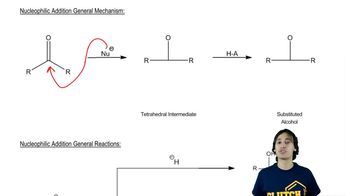
Nucleophilic Addition

Carbonyl Chemistry

Carbonyl compounds, characterized by a carbon-oxygen double bond, are key functional groups in organic chemistry. They can undergo nucleophilic addition reactions where nucleophiles attack the electrophilic carbon atom. The reactivity of carbonyls is influenced by the nature of the substituents attached to the carbonyl carbon, which can stabilize or destabilize the transition state during nucleophilic attack.
Video consigliato:
04:20
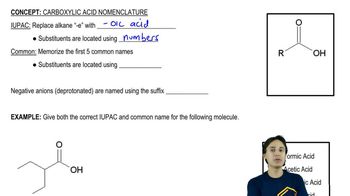
Carboxylic Acids Nomenclature

Carbocation Stability

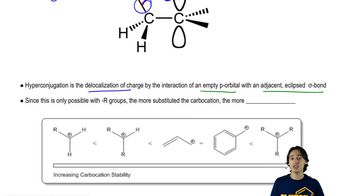
Carbocations are positively charged carbon species that can form during certain organic reactions, particularly when a leaving group departs. The stability of a carbocation is influenced by its degree (primary, secondary, tertiary) and the presence of electron-donating groups. Understanding carbocation stability is essential for predicting whether a nucleophile will add directly to a carbonyl or wait for a carbocation to form, as more stable carbocations are more likely to form and react.
Video consigliato:
05:58
Determining Carbocation Stability