Ch. 17 - Carbonyl Addition Reactions: Aldehydes and Ketones
Mullins - Organic Chemistry: A Learner Centered Approach 1st Edition
Mullins1st EditionOrganic Chemistry: A Learner Centered ApproachISBN: 9780137566471Non è quello che usi tu?Cambia libro di testo
Capitolo 16, Problema 11

Identify the bonds broken and formed in the following addition reaction.
(a) Would you expect this reaction to be favored based on entropy?
(b) Based on enthalpy [qualitatively]?
(c) Overall?
Chemical reaction showing the formation of an imine from an aldehyde and an amine, with bonds broken and formed indicated.

Guida verificata passo dopo passo
1
Identify the bonds broken: In the given reaction, the carbonyl group (C=O) in the cyclohexanone is broken. The pi bond of the carbonyl group is broken as the nucleophilic amine attacks the carbonyl carbon.
Identify the bonds formed: A new C-N bond is formed between the carbonyl carbon and the nitrogen of the amine. Additionally, an O-H bond is formed as the oxygen of the carbonyl group gains a hydrogen atom.
Entropy consideration: The reaction involves two reactant molecules combining to form a single product molecule. Generally, reactions that result in a decrease in the number of molecules are not favored by entropy, as entropy tends to favor an increase in disorder.
Enthalpy consideration: Qualitatively, the formation of new bonds (C-N and O-H) can release energy, making the reaction exothermic. Breaking the C=O pi bond requires energy, but the formation of stronger sigma bonds (C-N and O-H) can compensate for this, potentially making the reaction enthalpically favorable.
Overall consideration: The reaction may be favored overall if the enthalpic gain from forming new bonds outweighs the entropic loss from the decrease in the number of molecules. The reaction's favorability will depend on the balance between these enthalpic and entropic factors.

Risposta video verificata per un problema simile:

Questa soluzione video è stata consigliata dai nostri tutor come utile per risolvere questo problema.
Durata del video:
9m

Concetti chiave

Ecco i concetti essenziali che devi comprendere per rispondere correttamente alla domanda.

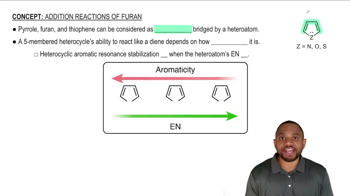
Addition Reactions

Addition reactions involve the breaking of π bonds (typically in alkenes or alkynes) and the formation of new σ bonds with reactants. In these reactions, two reactants combine to form a single product, which often leads to an increase in the number of bonds formed, impacting the overall stability and energy of the system.
Video consigliato:
Percorso guidato
1:42
Addition Reactions of Furan Concept 1

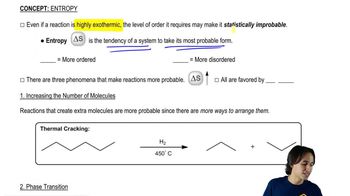
Entropy

Entropy is a measure of disorder or randomness in a system. In the context of chemical reactions, an increase in the number of gas molecules or a transition from a more ordered state to a less ordered state typically results in a positive change in entropy, favoring the reaction. Conversely, if a reaction leads to a decrease in the number of gas molecules, it may be less favored from an entropy perspective.
Video consigliato:
02:46
Explaining what entropy is.

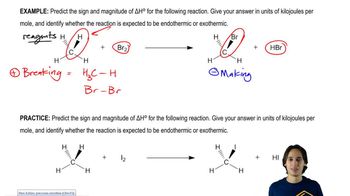
Enthalpy

Enthalpy refers to the total heat content of a system and is a key factor in determining the favorability of a reaction. A reaction is generally favored if it results in a decrease in enthalpy (exothermic reaction), as this indicates that energy is released. Conversely, endothermic reactions, which absorb energy, may be less favorable unless compensated by a significant increase in entropy.
Video consigliato:
04:38
Calculating Enthalpies