Ch. 17 - Carbonyl Addition Reactions: Aldehydes and Ketones
Mullins - Organic Chemistry: A Learner Centered Approach 1st Edition
Mullins1st EditionOrganic Chemistry: A Learner Centered ApproachISBN: 9780137566471Non è quello che usi tu?Cambia libro di testo
Capitolo 16, Problema 2c

Identify the following reactions as oxidation or reduction (based on what happens to the organic molecule).
(c) Reaction showing the conversion of a brominated compound to an alkene using sodium hydroxide, producing water and sodium bromide.

Guida verificata passo dopo passo
1
Step 1: Analyze the reaction. The starting material is cyclohexyl chloride (C6H11Cl), and the products are cyclohexene (C6H10), methanol (CH3OH), and sodium chloride (NaCl).
Step 2: Determine the change in the organic molecule. Cyclohexyl chloride loses a hydrogen atom and a chlorine atom, forming a double bond in cyclohexene. This indicates a change in the oxidation state of the carbon atoms.
Step 3: Recall the definition of oxidation and reduction. Oxidation involves the loss of electrons or an increase in the number of bonds to electronegative atoms (like oxygen) or the loss of hydrogen. Reduction involves the gain of electrons or an increase in the number of bonds to hydrogen.
Step 4: Evaluate the reaction. In this case, the organic molecule loses hydrogen atoms and forms a double bond, which corresponds to an increase in oxidation state. Therefore, this reaction is classified as an oxidation.
Step 5: Conclude that the reaction is an oxidation based on the changes observed in the organic molecule.

Risposta video verificata per un problema simile:

Questa soluzione video è stata consigliata dai nostri tutor come utile per risolvere questo problema.
Durata del video:
2m

Concetti chiave

Ecco i concetti essenziali che devi comprendere per rispondere correttamente alla domanda.

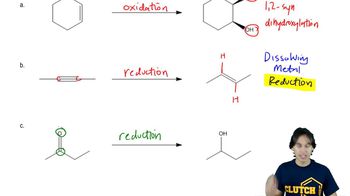
Oxidation and Reduction

Oxidation and reduction are chemical processes that involve the transfer of electrons between substances. Oxidation refers to the loss of electrons or an increase in oxidation state, while reduction involves the gain of electrons or a decrease in oxidation state. Understanding these concepts is crucial for identifying whether a reaction is an oxidation or reduction based on the changes occurring in the organic molecules.
Video consigliato:
00:54
Distinguishing between Oxidation and Reduction

Nucleophilic Substitution

Nucleophilic substitution is a fundamental reaction in organic chemistry where a nucleophile attacks an electrophile, resulting in the replacement of a leaving group. In the provided reaction, methanol acts as a nucleophile, attacking the carbon atom bonded to chlorine, leading to the formation of a new bond and the release of chloride ion. Recognizing this mechanism helps in determining the nature of the reaction.
Video consigliato:
01:47
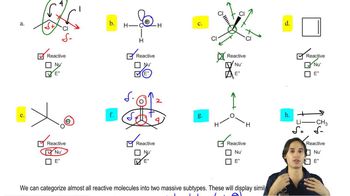
Nucleophiles and Electrophiles can react in Substitution Reactions.

Electrophiles and Nucleophiles

Electrophiles are electron-deficient species that seek electrons, while nucleophiles are electron-rich species that donate electrons. In the context of the reaction shown, the carbon atom attached to the chlorine atom acts as an electrophile, and methanol serves as a nucleophile. Understanding the roles of these species is essential for analyzing the reaction and determining whether it involves oxidation or reduction.
Video consigliato:
03:
Nucleophile or Electrophile