Ch. 17 - Carbonyl Addition Reactions: Aldehydes and Ketones
Mullins - Organic Chemistry: A Learner Centered Approach 1st Edition
Mullins1st EditionOrganic Chemistry: A Learner Centered ApproachISBN: 9780137566471Non è quello che usi tu?Cambia libro di testo
Capitolo 16, Problema 2a

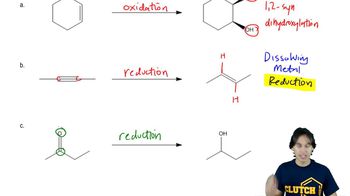
Identify the following reactions as oxidation or reduction (based on what happens to the organic molecule).
(a) Chemical reaction showing hydrogenation of an alkene to form an alkane, with nickel as a catalyst.

Guida verificata passo dopo passo
1
Step 1: Analyze the starting material and the product. The starting material contains a double bond in the cyclohexane ring, while the product has a fully saturated cyclohexane ring without any double bonds.
Step 2: Recognize the reaction conditions. The reaction involves hydrogen gas (H₂) and a palladium catalyst (Pd/C), which is a typical setup for catalytic hydrogenation.
Step 3: Understand the process of catalytic hydrogenation. In this reaction, hydrogen atoms are added across the double bond, converting the unsaturated compound (with a double bond) into a saturated compound (without a double bond).
Step 4: Determine whether the reaction is oxidation or reduction. Reduction involves the gain of hydrogen atoms or the loss of oxygen atoms. Since hydrogen is added to the molecule, this reaction is classified as a reduction.
Step 5: Conclude that the organic molecule undergoes a reduction in this reaction, as the double bond is reduced to a single bond through the addition of hydrogen.

Risposta video verificata per un problema simile:

Questa soluzione video è stata consigliata dai nostri tutor come utile per risolvere questo problema.
Durata del video:
2m

Concetti chiave

Ecco i concetti essenziali che devi comprendere per rispondere correttamente alla domanda.

Oxidation and Reduction

In organic chemistry, oxidation refers to the loss of electrons or an increase in oxidation state, while reduction involves the gain of electrons or a decrease in oxidation state. These processes often involve the addition or removal of specific atoms or groups, such as oxygen or hydrogen, to or from a molecule.
Video consigliato:
00:54
Distinguishing between Oxidation and Reduction

Hydrogenation

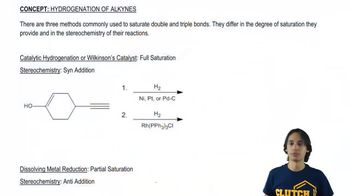
Hydrogenation is a specific type of reduction reaction where hydrogen (H2) is added to an unsaturated compound, such as an alkene or alkyne, converting it into a saturated compound. This process typically requires a catalyst, such as palladium on carbon (Pd/C), to facilitate the reaction and lower the activation energy.
Video consigliato:
00:48
The definition of hydrogenation.

Catalysts in Organic Reactions

Catalysts are substances that increase the rate of a chemical reaction without being consumed in the process. In the context of hydrogenation, catalysts like Pd/C provide a surface for the reaction to occur, allowing hydrogen to effectively add to the double bond of the alkene, thus promoting the reduction of the molecule.
Video consigliato:
Percorso guidato
1:22
Introduction to Catalysis Example 1