Ch. 17 - Carbonyl Addition Reactions: Aldehydes and Ketones
Mullins - Organic Chemistry: A Learner Centered Approach 1st Edition
Mullins1st EditionOrganic Chemistry: A Learner Centered ApproachISBN: 9780137566471Non è quello che usi tu?Cambia libro di testo
Capitolo 16, Problema 1d

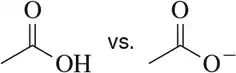
In each case, circle the stronger nucleophile.
(d) Chemical structures comparing hydroxide and oxide ions, highlighting the stronger nucleophile with a circle.

Guida verificata passo dopo passo
1
Step 1: Understand the concept of nucleophilicity. Nucleophilicity refers to the ability of a species to donate a pair of electrons to an electrophile. Stronger nucleophiles are typically more negatively charged, less sterically hindered, and less stabilized by resonance or electronegative atoms.
Step 2: Analyze the chemical structures provided. Formic acid (a) has a neutral hydroxyl group (-OH) attached to the carbonyl carbon, while formate (b) is the conjugate base of formic acid and carries a negative charge on the oxygen atom.
Step 3: Consider the role of charge. Negatively charged species, like formate (b), are generally stronger nucleophiles than their neutral counterparts because the negative charge increases their electron density, making them more reactive.
Step 4: Evaluate resonance stabilization. Formate (b) has resonance structures that delocalize the negative charge, but it still retains a higher electron density compared to the neutral formic acid (a), making it a stronger nucleophile.
Step 5: Conclude that formate (b) is the stronger nucleophile compared to formic acid (a) due to its negative charge and higher electron density.

Risposta video verificata per un problema simile:

Questa soluzione video è stata consigliata dai nostri tutor come utile per risolvere questo problema.
Durata del video:
2m

Concetti chiave

Ecco i concetti essenziali che devi comprendere per rispondere correttamente alla domanda.

Nucleophilicity

Nucleophilicity refers to the ability of a species to donate an electron pair to an electrophile during a chemical reaction. Stronger nucleophiles are typically negatively charged or have lone pairs of electrons that can be readily donated. In this context, comparing formic acid and formate involves assessing their ability to act as nucleophiles based on their structure and charge.
Video consigliato:
08:27
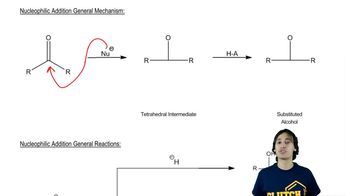
Nucleophilic Addition

Acid-Base Chemistry

Understanding acid-base chemistry is crucial for determining nucleophilicity. Formic acid (a weak acid) can donate a proton (H+) to form the formate ion, which is its conjugate base. The presence of a negative charge on formate enhances its nucleophilicity compared to the neutral formic acid, making it a stronger nucleophile in reactions.
Video consigliato:
02:49
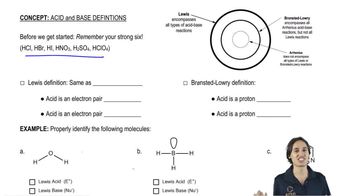
The Lewis definition of acids and bases.

Resonance Stabilization

Resonance stabilization plays a significant role in the reactivity of nucleophiles. The formate ion can delocalize its negative charge over the oxygen atoms, which stabilizes the ion and enhances its nucleophilic character. In contrast, formic acid lacks this resonance stabilization for nucleophilic attack, making formate the stronger nucleophile in this comparison.
Video consigliato:
03:43
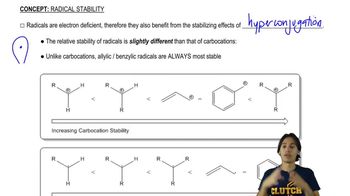
The radical stability trend.