Ch. 17 - Carbonyl Addition Reactions: Aldehydes and Ketones
Mullins - Organic Chemistry: A Learner Centered Approach 1st Edition
Mullins1st EditionOrganic Chemistry: A Learner Centered ApproachISBN: 9780137566471Non è quello che usi tu?Cambia libro di testo
Capitolo 16, Problema 31c

Identify the hemiacetal functional group in each of the following molecules. These molecules may not be stable enough to be the favorable product in an equilibrium reaction.
(c) Structural representation of a hemiacetal functional group with an oxygen and hydroxyl group.

Guida verificata passo dopo passo
1
Understand the structure of a hemiacetal: A hemiacetal is formed when an alcohol adds to an aldehyde or ketone. It contains a carbon atom bonded to an -OH group, an -OR group, a hydrogen atom (in the case of aldehydes), and an alkyl or aryl group.
Examine the given molecule structure in the image. Look for a carbon atom that is bonded to both an -OH group and an -OR group. This is the key feature of a hemiacetal.
Check the connectivity of the carbon atom: Ensure that the carbon atom with the -OH and -OR groups is also bonded to either a hydrogen atom (if derived from an aldehyde) or another carbon atom (if derived from a ketone).
Verify the presence of the hemiacetal group: Confirm that the identified carbon atom does not have any additional substituents that would disqualify it from being a hemiacetal.
Once the hemiacetal group is identified, consider the stability of the molecule. Note that hemiacetals are often unstable and may not be the predominant form in equilibrium, but the task is to identify the functional group, not to assess stability.

Risposta video verificata per un problema simile:

Questa soluzione video è stata consigliata dai nostri tutor come utile per risolvere questo problema.
Durata del video:
3m

Concetti chiave

Ecco i concetti essenziali che devi comprendere per rispondere correttamente alla domanda.

Hemiacetal Structure

A hemiacetal is formed when an aldehyde or ketone reacts with an alcohol, resulting in a carbon atom bonded to both a hydroxyl group (-OH) and an alkoxy group (-OR). This functional group is characterized by the presence of one -OH and one -OR group attached to the same carbon, which is typically derived from the carbonyl carbon of the original aldehyde or ketone.
Video consigliato:
06:23
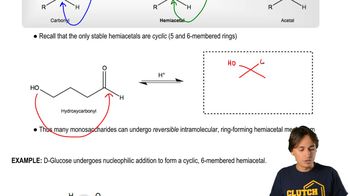
Monosaccharides - Forming Cyclic Hemiacetals

Equilibrium in Organic Reactions

In organic chemistry, equilibrium refers to the state where the rate of the forward reaction equals the rate of the reverse reaction, leading to constant concentrations of reactants and products. Understanding equilibrium is crucial for predicting the stability of hemiacetals, as they may not be the favored product in a reaction, especially if the equilibrium lies towards the reactants.
Video consigliato:
04:00
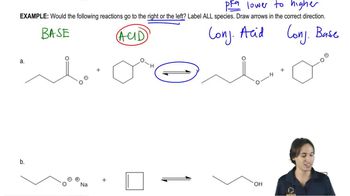
Determining Acid/Base Equilibrium

Stability of Hemiacetals

Hemiacetals are often less stable than their corresponding acetals, which are formed when a hemiacetal reacts with another alcohol. The stability of a hemiacetal can be influenced by steric factors, electronic effects, and the nature of the substituents on the carbon atom. In many cases, hemiacetals exist in equilibrium with their parent carbonyl compounds, making them transient species in organic reactions.
Video consigliato:
06:23
Monosaccharides - Forming Cyclic Hemiacetals