Ch. 17 - Carbonyl Addition Reactions: Aldehydes and Ketones
Mullins - Organic Chemistry: A Learner Centered Approach 1st Edition
Mullins1st EditionOrganic Chemistry: A Learner Centered ApproachISBN: 9780137566471Non è quello che usi tu?Cambia libro di testo
Capitolo 16, Problema 1c

In each case, circle the stronger nucleophile.
(c) Stronger nucleophile comparison between cyanide ion and water, with cyanide circled.

Guida verificata passo dopo passo
1
Step 1: Understand the concept of nucleophilicity. Nucleophilicity refers to the ability of a species to donate a pair of electrons to an electrophile. It is influenced by factors such as charge, electronegativity, steric hindrance, and solvent effects.
Step 2: Analyze the charge of the species. Generally, negatively charged species are stronger nucleophiles than their neutral counterparts because they have a higher electron density available for donation.
Step 3: Consider electronegativity. Less electronegative atoms are better nucleophiles because they hold onto their electrons less tightly, making them more willing to donate them.
Step 4: Evaluate steric hindrance. Bulky groups around the nucleophilic atom can hinder its ability to approach the electrophile, reducing nucleophilicity.
Step 5: Account for solvent effects. In polar protic solvents, nucleophilicity decreases for smaller, more electronegative atoms due to hydrogen bonding. In polar aprotic solvents, nucleophilicity trends are more directly related to charge and electronegativity.

Risposta video verificata per un problema simile:

Questa soluzione video è stata consigliata dai nostri tutor come utile per risolvere questo problema.
Durata del video:
2m

Concetti chiave

Ecco i concetti essenziali che devi comprendere per rispondere correttamente alla domanda.

Nucleophilicity

Nucleophilicity refers to the ability of a species to donate an electron pair to an electrophile during a chemical reaction. Stronger nucleophiles are typically characterized by their high electron density and low electronegativity, which allows them to readily attack positively charged or electron-deficient centers. Factors such as charge, solvent effects, and steric hindrance also influence nucleophilicity.
Video consigliato:
08:27
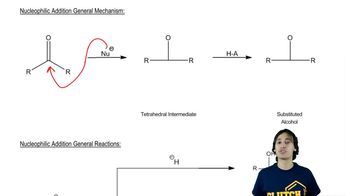
Nucleophilic Addition

Charge and Nucleophilicity

The charge of a nucleophile significantly affects its strength. Anions (negatively charged species) are generally stronger nucleophiles than their neutral counterparts because they possess an extra electron that can be donated. For example, hydroxide ion (OH-) is a stronger nucleophile than water (H2O) due to its negative charge, which enhances its electron-donating ability.
Video consigliato:
01:34
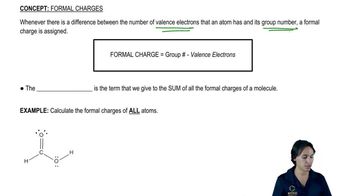
Calculating formal and net charge.

Solvent Effects

The solvent in which a reaction occurs can greatly influence nucleophilicity. Polar protic solvents can stabilize nucleophiles through hydrogen bonding, often reducing their reactivity, while polar aprotic solvents do not stabilize nucleophiles as effectively, allowing them to remain more reactive. Understanding the solvent's role is crucial for predicting the behavior of nucleophiles in various chemical environments.
Video consigliato:
01:16
Identification of polarity in solvents