Ch. 17 - Carbonyl Addition Reactions: Aldehydes and Ketones
Mullins - Organic Chemistry: A Learner Centered Approach 1st Edition
Mullins1st EditionOrganic Chemistry: A Learner Centered ApproachISBN: 9780137566471Non è quello che usi tu?Cambia libro di testo
Capitolo 16, Problema 62

Starting with formaldehyde and the alkyl halides shown as the only sources of carbon, provide a synthesis of the following alcohol.
Chemical reaction diagram showing alcohol synthesis to spiroketal using formaldehyde and alkyl halides.

Guida verificata passo dopo passo
1
Step 1: Begin by identifying the target alcohol structure from the image. The alcohol has a hydroxyl group on each end of a carbon chain with a ketone group in the middle. This suggests a synthesis involving multiple carbon-carbon bond formations.
Step 2: Use formaldehyde as the starting material. Formaldehyde can be used to form primary alcohols through reactions such as the Grignard reaction. Consider how formaldehyde can be converted into a longer carbon chain using alkyl halides.
Step 3: Plan the synthesis by considering the formation of the carbon backbone. You can use alkyl halides to extend the carbon chain. For example, a Grignard reagent can be formed from an alkyl halide, which can then react with formaldehyde to form a primary alcohol.
Step 4: Once the carbon chain is extended, introduce the ketone group. This can be done by oxidizing a secondary alcohol to a ketone using an oxidizing agent like PCC (Pyridinium chlorochromate).
Step 5: Finally, ensure the hydroxyl groups are correctly positioned on the carbon chain. This may involve additional reactions such as protection/deprotection strategies or further Grignard reactions to achieve the desired alcohol structure.

Risposta video verificata per un problema simile:

Questa soluzione video è stata consigliata dai nostri tutor come utile per risolvere questo problema.
Durata del video:
2m

Concetti chiave

Ecco i concetti essenziali che devi comprendere per rispondere correttamente alla domanda.

Formaldehyde as a Carbon Source

Formaldehyde (HCHO) is the simplest aldehyde and serves as a versatile carbon source in organic synthesis. It can participate in various reactions, such as nucleophilic additions, where it can react with nucleophiles to form alcohols. Understanding its reactivity is crucial for constructing complex molecules from simpler ones.
Video consigliato:
02:12
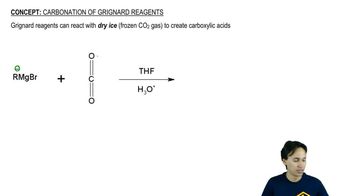
Carbonation of Grignard Reagents

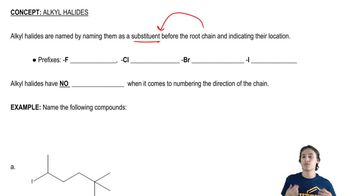
Alkyl Halides in Synthesis

Alkyl halides are organic compounds containing a carbon-halogen bond, which can undergo nucleophilic substitution or elimination reactions. They are important intermediates in organic synthesis, allowing for the introduction of functional groups or the formation of new carbon-carbon bonds. Recognizing how to manipulate these compounds is essential for constructing desired alcohols.
Video consigliato:
01:52
How to name alkyl halides

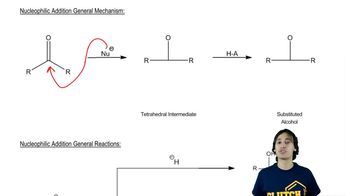
Nucleophilic Addition Reactions

Nucleophilic addition reactions involve the attack of a nucleophile on an electrophilic carbon atom, such as that in carbonyl compounds like aldehydes. This reaction is fundamental in organic chemistry for forming alcohols from carbonyl precursors. Understanding the mechanism and conditions for these reactions is vital for successful synthesis.
Video consigliato:
08:27
Nucleophilic Addition