Ch. 17 - Carbonyl Addition Reactions: Aldehydes and Ketones
Mullins - Organic Chemistry: A Learner Centered Approach 1st Edition
Mullins1st EditionOrganic Chemistry: A Learner Centered ApproachISBN: 9780137566471Non è quello che usi tu?Cambia libro di testo
Capitolo 16, Problema 66b

Suggest a synthetic scheme, involving a protecting group, to generate the molecule shown starting with the molecule at the left.
(b) Synthetic scheme showing the transformation of a molecule with carbonyl groups into a product with a protecting group.

Guida verificata passo dopo passo
1
Identify the functional groups in the starting material and the target molecule. The starting material is an aldehyde, and the target molecule has an additional ether group and a longer carbon chain.
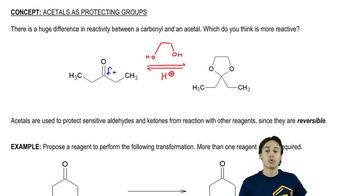
Select a protecting group for the aldehyde to prevent it from reacting during the chain extension process. A common choice is the acetal protecting group, which can be formed by reacting the aldehyde with an alcohol in the presence of an acid catalyst.
Extend the carbon chain by performing a Grignard reaction. First, convert the alkyl halide to a Grignard reagent, then react it with the protected aldehyde to form the extended carbon chain.
Introduce the ether group by performing a Williamson ether synthesis. This involves reacting an alcohol with an alkyl halide in the presence of a base to form the ether linkage.
Finally, remove the protecting group to regenerate the aldehyde functionality. This can be done by hydrolysis of the acetal under acidic conditions, yielding the target molecule.

Risposta video verificata per un problema simile:

Questa soluzione video è stata consigliata dai nostri tutor come utile per risolvere questo problema.
Durata del video:
10m

Concetti chiave

Ecco i concetti essenziali che devi comprendere per rispondere correttamente alla domanda.

Protecting Groups

Protecting groups are temporary modifications used in organic synthesis to prevent certain functional groups from reacting during a chemical transformation. They allow chemists to selectively modify other parts of a molecule without interference. After the desired reactions are completed, the protecting group can be removed to restore the original functional group.
Video consigliato:
02:44
Protecting Groups

Synthetic Pathway

A synthetic pathway is a series of chemical reactions that lead to the formation of a desired product from a starting material. It involves strategic planning to determine the order of reactions, the reagents needed, and the conditions required to achieve the target molecule efficiently. Understanding the reactivity and compatibility of different functional groups is crucial in designing an effective synthetic pathway.
Video consigliato:
Percorso guidato
2:13
Energy Production In Biochemical Pathways Concept 1

Functional Group Interconversion

Functional group interconversion refers to the transformation of one functional group into another within a molecule. This concept is essential in organic synthesis as it allows chemists to modify the reactivity and properties of a compound. Mastery of various reactions that facilitate these conversions is vital for constructing complex molecules and achieving specific synthetic goals.
Video consigliato:
02:36
Identifying Functional Groups