Ch. 17 - Carbonyl Addition Reactions: Aldehydes and Ketones
Mullins - Organic Chemistry: A Learner Centered Approach 1st Edition
Mullins1st EditionOrganic Chemistry: A Learner Centered ApproachISBN: 9780137566471Non è quello che usi tu?Cambia libro di testo
Capitolo 16, Problema 66a

Suggest a synthetic scheme, involving a protecting group, to generate the molecule shown starting with the molecule at the left.
(a) Chemical reaction scheme showing conversion of an alkyne to a ketone with an isopropyl group.

Guida verificata passo dopo passo
1
Identify the functional groups present in both the starting material and the target molecule. Determine which functional groups need to be protected during the synthesis to prevent unwanted reactions.
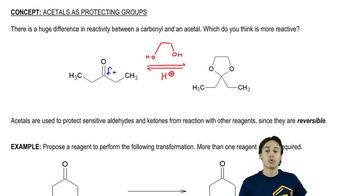
Select an appropriate protecting group for the functional group that needs protection. Common protecting groups include silyl ethers for alcohols or acetals for carbonyl groups.
Perform the protection step by reacting the starting material with the protecting group reagent under suitable conditions. This will temporarily mask the reactive site.
Carry out the necessary synthetic transformations on the protected molecule to introduce the desired functional groups or structural changes required to reach the target molecule.
Finally, remove the protecting group under conditions that do not affect the newly formed functional groups, thus revealing the original functional group in the target molecule.

Risposta video verificata per un problema simile:

Questa soluzione video è stata consigliata dai nostri tutor come utile per risolvere questo problema.

Concetti chiave

Ecco i concetti essenziali che devi comprendere per rispondere correttamente alla domanda.

Protecting Groups

Protecting groups are chemical groups used in organic synthesis to temporarily mask reactive sites on a molecule, allowing selective reactions to occur elsewhere. They are crucial in multi-step syntheses to prevent unwanted reactions at sensitive functional groups. Common examples include silyl ethers for alcohols and acetals for aldehydes.
Video consigliato:
02:44
Protecting Groups

Synthetic Scheme

A synthetic scheme is a planned sequence of chemical reactions designed to convert starting materials into a desired product. It involves selecting appropriate reagents, conditions, and intermediates, often using protecting groups to control reactivity. Understanding reaction mechanisms and functional group transformations is essential for designing effective synthetic routes.
Video consigliato:
16:21
Review of Cheatsheet

Functional Group Transformation

Functional group transformation refers to the conversion of one functional group into another through chemical reactions. This concept is fundamental in organic synthesis, enabling the modification of molecular structures to achieve desired properties or reactivity. Techniques include oxidation, reduction, substitution, and addition reactions, each requiring specific conditions and reagents.
Video consigliato:
02:36
Identifying Functional Groups