
Fluoxetine, an antidepressant, is better known as Prozac®. Suggest reagents that could be used to make the indicated C–O bond of fluoxetine. [Note that CF3, an electron-withdrawing group, is para to where the new bond will be formed.]

Mullins 1st Edition
Ch. 23 - Benzene 1: Aromatic Stability and Substitution Reactions
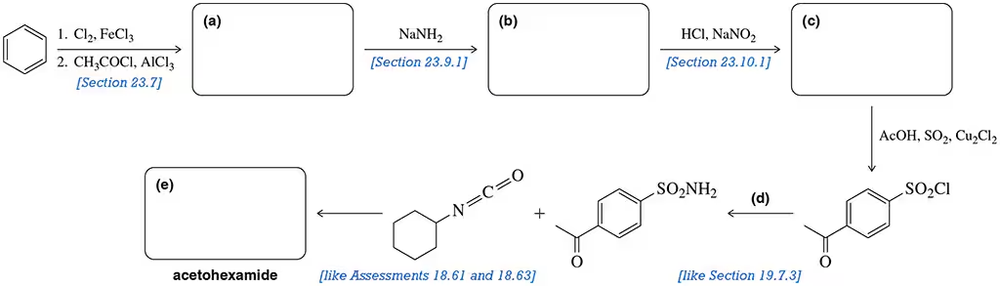
Problema 84Acetohexamide is used to treat type 2 diabetes that cannot be well controlled by diet alone. Fill in the blanks of the synthetic scheme used to synthesize acetohexamide. [Hints have been provided below each step.]

Guida verificata passo dopo passo
Risposta video verificata per un problema simile:
Concetti chiave
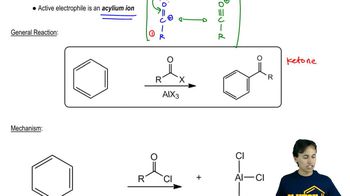
Friedel-Crafts Acylation
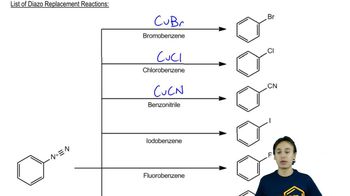
Diazotization and Sandmeyer Reaction
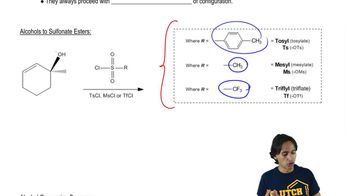
Sulfonyl Chloride Formation and Reaction
How might you use 13C NMR spectroscopy to differentiate between the possible ortho, meta, and para products of the electrophilic aromatic substitution reaction shown?
Would you expect chlorination to occur ortho, para, or meta to the pyridinium ion in the following molecule? Explain your answer.
Suggest an arrow-pushing mechanism of the following rearrangement.
Indigo is a dye that was originally isolated from coal tar. In 1905, Johann Friedrich Wilhelm Adolf von Baeyer won a Nobel Prize for a method that allowed indigo to be isolated from plants [a green chemist ahead of his time.] If you nitrated indigo using the reaction learned in this chapter, at which carbon would you expect the nitro group to attach?
Addition by the benzyne mechanism is not usually regioselective. Explain the fact that the reaction shown is highly regioselective for the product shown.