
Ch. 23 - Benzene 1: Aromatic Stability and Substitution Reactions
Mullins - Organic Chemistry: A Learner Centered Approach 1st Edition
Mullins1st EditionOrganic Chemistry: A Learner Centered ApproachISBN: 9780137566471Non è quello che usi tu?Cambia libro di testo
Capitolo 22, Problema 85

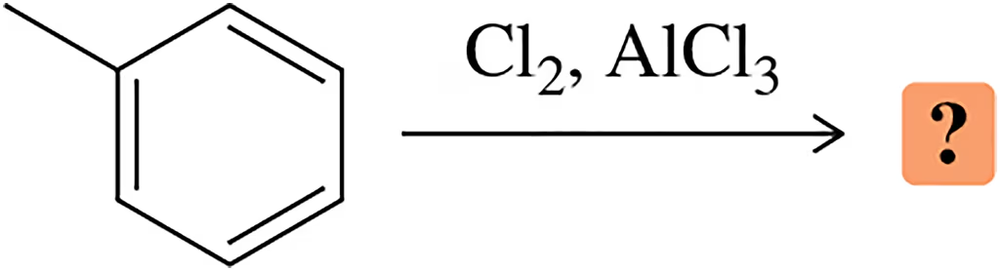
How might you use 13C NMR spectroscopy to differentiate between the possible ortho, meta, and para products of the electrophilic aromatic substitution reaction shown?
Chemical reaction: toluene with Cl2 and AlCl3, arrow pointing to a question mark, indicating unknown product.

Guida verificata passo dopo passo
1
Understand the structure of ortho, meta, and para substituted benzene rings. In ortho substitution, the substituents are adjacent, in meta they are separated by one carbon, and in para they are opposite each other on the benzene ring.
Recognize that ¹³C NMR spectroscopy provides information about the carbon environment in a molecule. Each unique carbon environment will give rise to a distinct signal in the ¹³C NMR spectrum.
For the ortho product, identify that there will be more unique carbon environments due to the proximity of the substituents, leading to more signals in the ¹³C NMR spectrum.
For the meta product, note that the substituents are separated by one carbon, which will result in a different pattern of unique carbon environments compared to the ortho and para products.
For the para product, observe that the symmetry of the molecule will result in fewer unique carbon environments, leading to fewer signals in the ¹³C NMR spectrum compared to the ortho and meta products.

Risposta video verificata per un problema simile:

Questa soluzione video è stata consigliata dai nostri tutor come utile per risolvere questo problema.

Concetti chiave

Ecco i concetti essenziali che devi comprendere per rispondere correttamente alla domanda.

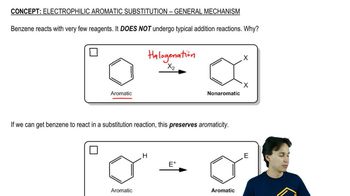
Electrophilic Aromatic Substitution

Electrophilic aromatic substitution is a reaction where an electrophile replaces a hydrogen atom in an aromatic ring. Understanding the positions of substitution (ortho, meta, para) is crucial, as they affect the chemical environment of the carbon atoms in the ring, which can be detected using ¹³C NMR spectroscopy.
Video consigliato:
03:07
EAS Review

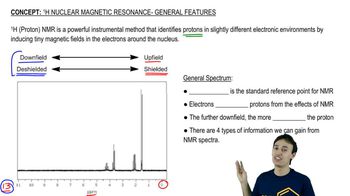
¹³C NMR Spectroscopy

¹³C NMR spectroscopy is a technique used to observe the carbon atoms in a molecule. It provides information about the chemical environment of each carbon, which can help differentiate between ortho, meta, and para substitution patterns in aromatic compounds based on the distinct chemical shifts and splitting patterns of the carbon signals.
Video consigliato:
10:06
General NMR Features

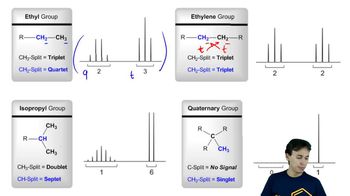
Chemical Shift and Splitting Patterns

Chemical shift refers to the position of an NMR signal, influenced by the electronic environment surrounding a nucleus. In ¹³C NMR, ortho, meta, and para substitutions cause different shifts due to variations in electron density and steric effects. Splitting patterns can further aid in distinguishing these positions by showing how neighboring atoms affect the carbon signals.
Video consigliato:
08:06
Common Splitting Patterns