
Ch. 23 - Benzene 1: Aromatic Stability and Substitution Reactions
Mullins - Organic Chemistry: A Learner Centered Approach 1st Edition
Mullins1st EditionOrganic Chemistry: A Learner Centered ApproachISBN: 9780137566471Non è quello che usi tu?Cambia libro di testo
Capitolo 22, Problema 86

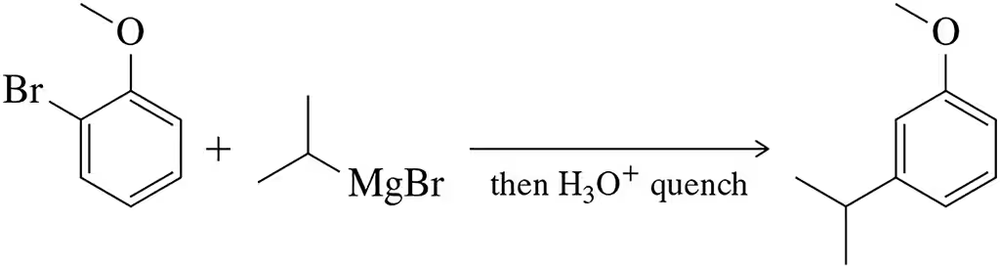
Addition by the benzyne mechanism is not usually regioselective. Explain the fact that the reaction shown is highly regioselective for the product shown.
Reaction scheme showing a regioselective addition of MgBr to a brominated aromatic compound, followed by quenching with water.

Guida verificata passo dopo passo
1
Identify the starting materials: The reaction involves a brominated anisole and an isopropyl Grignard reagent (isopropylmagnesium bromide).
Understand the benzyne mechanism: The reaction likely proceeds through a benzyne intermediate, which is formed by the elimination of the bromine atom and a hydrogen atom from the aromatic ring, generating a highly reactive triple-bonded species.
Consider the regioselectivity: The benzyne intermediate can react with the Grignard reagent at two possible positions, but the presence of the methoxy group (OCH3) on the aromatic ring influences the regioselectivity.
Analyze the electronic effects: The methoxy group is an electron-donating group through resonance, which stabilizes the negative charge at the ortho and para positions relative to itself. This makes the ortho position more favorable for nucleophilic attack by the Grignard reagent.
Conclude the regioselectivity: The reaction is regioselective because the Grignard reagent preferentially attacks the ortho position relative to the methoxy group, leading to the observed product with the isopropyl group adjacent to the methoxy group.

Risposta video verificata per un problema simile:

Questa soluzione video è stata consigliata dai nostri tutor come utile per risolvere questo problema.

Concetti chiave

Ecco i concetti essenziali che devi comprendere per rispondere correttamente alla domanda.

Benzyne Mechanism

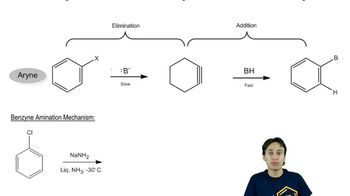
The benzyne mechanism involves the formation of a highly reactive intermediate known as benzyne, which is generated by the elimination of a leaving group from a substituted aromatic compound. This intermediate can undergo nucleophilic addition reactions, but these reactions are typically not regioselective due to the symmetrical nature of the benzyne structure, allowing for multiple possible products.
Video consigliato:
06:06
General Mechanism

Regioselectivity

Regioselectivity refers to the preference of a chemical reaction to yield one structural isomer over others when multiple products are possible. In the context of the reaction shown, the regioselectivity is influenced by the stability of the intermediates formed during the reaction, as well as steric and electronic factors that favor the formation of a specific product.
Video consigliato:
05:09
Heck Reaction

Nucleophilic Addition

Nucleophilic addition is a fundamental reaction in organic chemistry where a nucleophile attacks an electrophilic center, leading to the formation of a new bond. In the reaction depicted, the nucleophile (MgBr) adds to the electrophilic carbon of the benzyne intermediate, resulting in a regioselective product due to the specific orientation and electronic effects of the substituents on the aromatic ring.
Video consigliato:
08:27
Nucleophilic Addition