Ch. 24 - Benzene 2: Reactions Influenced by the Aromatic Ring
Mullins - Organic Chemistry: A Learner Centered Approach 1st Edition
Mullins1st EditionOrganic Chemistry: A Learner Centered ApproachISBN: 9780137566471Non è quello che usi tu?Cambia libro di testo
Capitolo 23, Problema 35c

Suggest the reagents used to effect the transformations shown.
(c) Chemical reaction showing ether cleavage, producing a phenol and a cyclic ether. Reagents for transformation suggested.

Guida verificata passo dopo passo
1
Identify the starting material and the products. The starting material is an ether with a phenyl group and a cyclopropyl group. The products are toluene and cyclopropanol.
Recognize that the transformation involves breaking the ether bond and forming an alcohol group on the cyclopropyl moiety while converting the phenyl group to toluene.
Consider the mechanism of ether cleavage. Acidic conditions are typically used to cleave ethers, often involving a strong acid like HBr or HI.
Propose the use of a strong acid such as HBr or HI to cleave the ether bond. The acid will protonate the ether oxygen, making it a better leaving group.
The protonated ether can then undergo nucleophilic attack by the halide ion, leading to the formation of toluene and cyclopropanol as the final products.

Risposta video verificata per un problema simile:

Questa soluzione video è stata consigliata dai nostri tutor come utile per risolvere questo problema.

Concetti chiave

Ecco i concetti essenziali che devi comprendere per rispondere correttamente alla domanda.

Ether Cleavage

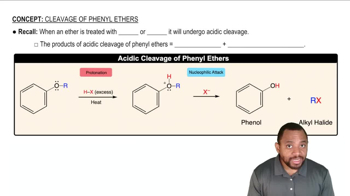
Ether cleavage involves breaking the C-O bond in ethers, typically using strong acids like HI or HBr. The reaction often results in the formation of alcohols and alkyl halides. In this transformation, the ether is cleaved to produce a phenol and a cyclic ether, indicating the use of acidic conditions to facilitate the cleavage.
Video consigliato:
Percorso guidato
1:45
Cleavage of Phenyl Ethers Concept 1

Acidic Conditions

Acidic conditions are crucial for ether cleavage, as they protonate the ether oxygen, making the C-O bond more susceptible to nucleophilic attack. Common acids used include hydrobromic acid (HBr) or hydroiodic acid (HI), which can effectively cleave ethers to form alcohols and other products, as seen in the transformation to phenol and a cyclic ether.
Video consigliato:
02:23
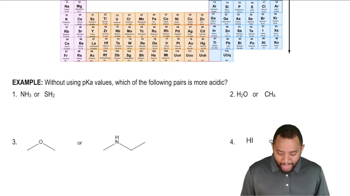
Using factors affecting acidity to rank acids

Phenol Formation

Phenol formation in ether cleavage reactions occurs when the aromatic ring stabilizes the resulting carbocation, allowing the formation of a stable phenol product. This stability is due to resonance within the aromatic ring, which is a key factor in the transformation shown, where the ether is cleaved to yield a phenol and a cyclic ether.
Video consigliato:
02:27
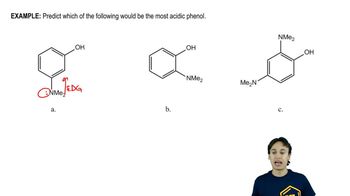
Identify the most acidic phenol