Ch. 24 - Benzene 2: Reactions Influenced by the Aromatic Ring
Mullins - Organic Chemistry: A Learner Centered Approach 1st Edition
Mullins1st EditionOrganic Chemistry: A Learner Centered ApproachISBN: 9780137566471Non è quello che usi tu?Cambia libro di testo
Capitolo 23, Problema 37

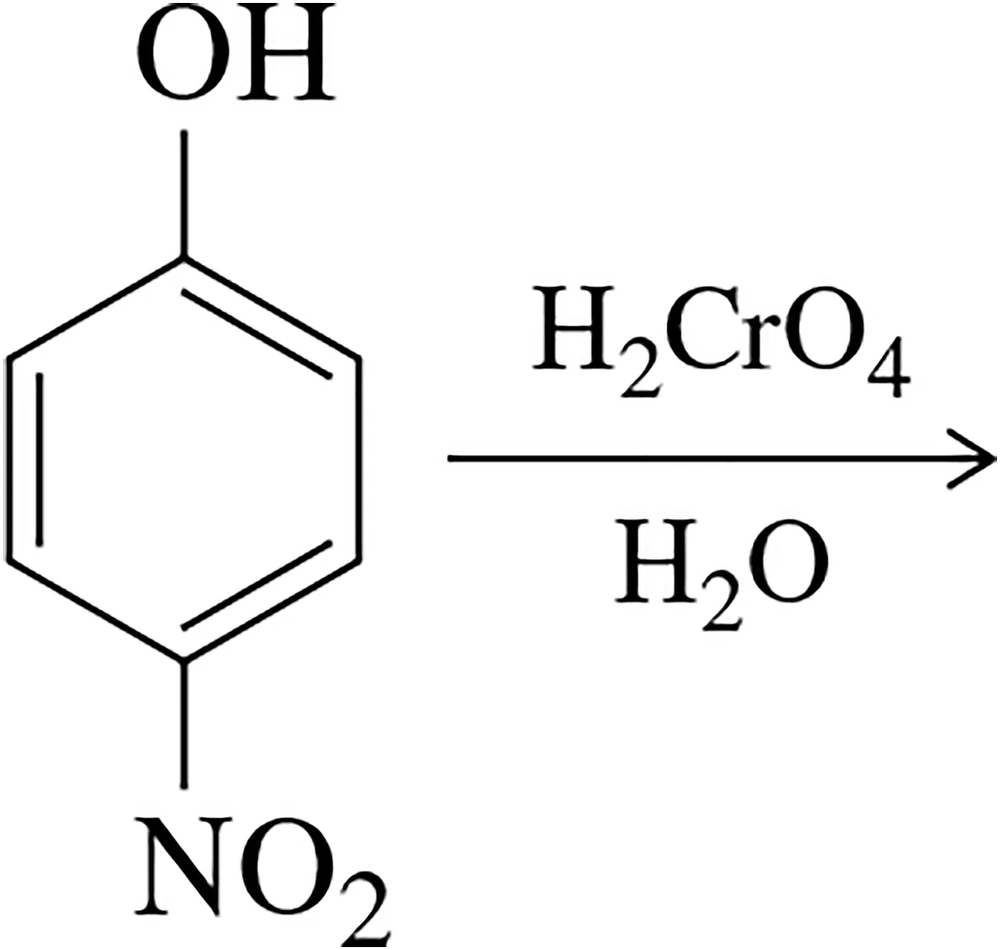
Oxidation of the phenol shown gives a single quinone product. Predict this product and explain why it is the only one formed.
Chemical structure of phenol with hydroxyl and nitro groups, showing oxidation reaction with H2CrO4 to form a quinone.

Guida verificata passo dopo passo
1
Identify the starting material: The phenol shown in the image is 4-nitrophenol, which has a hydroxyl group (OH) at the para position relative to the nitro group (NO2) on the benzene ring.
Understand the reaction conditions: The reagent used is chromic acid (H2CrO4) in water, which is a strong oxidizing agent commonly used to oxidize phenols to quinones.
Predict the oxidation process: In the oxidation of phenols, the hydroxyl group is converted into a carbonyl group, forming a quinone. The para position of the phenol is typically oxidized to form a para-quinone.
Consider the influence of substituents: The nitro group (NO2) is an electron-withdrawing group, which stabilizes the formation of the quinone by withdrawing electron density from the ring, making the para position more susceptible to oxidation.
Explain the formation of a single product: Due to the electron-withdrawing effect of the nitro group, the para position is the most reactive site for oxidation, leading to the formation of a single para-quinone product, rather than multiple quinone isomers.

Risposta video verificata per un problema simile:

Questa soluzione video è stata consigliata dai nostri tutor come utile per risolvere questo problema.
Durata del video:
6m

Concetti chiave

Ecco i concetti essenziali che devi comprendere per rispondere correttamente alla domanda.

Phenol Structure and Reactivity

Phenols are aromatic compounds with a hydroxyl (-OH) group attached to a benzene ring. Their structure allows for resonance stabilization, which enhances their reactivity in oxidation reactions. Understanding the specific phenol structure is crucial for predicting the oxidation products, as the position of the hydroxyl group influences the outcome.
Video consigliato:
02:27
Identify the most acidic phenol

Oxidation Mechanism

Oxidation in organic chemistry typically involves the loss of electrons or an increase in oxidation state. In the case of phenols, oxidation can lead to the formation of quinones, which are cyclic compounds with two carbonyl groups. The mechanism often involves the formation of a radical intermediate, which can stabilize and rearrange to yield a single product, depending on the substituents on the aromatic ring.
Video consigliato:
01:31
Oxidative Workup Mechanism:

Quinone Formation and Stability

Quinones are highly stable compounds formed from the oxidation of phenols. The stability arises from the delocalization of electrons in the conjugated system of the quinone structure. In cases where a single quinone product is formed, it indicates that the oxidation process leads to a unique arrangement of carbonyl groups that minimizes steric hindrance and maximizes resonance stabilization.
Video consigliato:
Percorso guidato
1:47
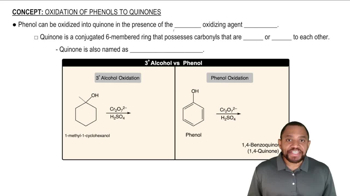
Oxidation of Phenols to Quinones Concept 1