Ch. 24 - Benzene 2: Reactions Influenced by the Aromatic Ring
Mullins - Organic Chemistry: A Learner Centered Approach 1st Edition
Mullins1st EditionOrganic Chemistry: A Learner Centered ApproachISBN: 9780137566471Non è quello che usi tu?Cambia libro di testo
Capitolo 23, Problema 38

In the second propagation step in the bromination of toluene, Br2 is only attacked by a radical on the substituent carbon. Why?
Diagram illustrating the bromination mechanism of toluene, highlighting radical formation and Br₂ attack on the substituent carbon.

Guida verificata passo dopo passo
1
Identify the radical species involved in the bromination of toluene. In this case, the radical is located on the benzylic carbon, which is the carbon directly attached to the benzene ring.
Understand the concept of radical stability. The benzylic radical is stabilized by resonance, as the unpaired electron can be delocalized over the aromatic ring, making it more stable than a radical on a non-benzylic carbon.
Recognize that in the second propagation step, the radical on the benzylic carbon attacks a bromine molecule (Br₂). This is because the benzylic radical is more reactive due to its stability and the ability to form a new C-Br bond.
Consider the mechanism of the reaction. The radical on the benzylic carbon abstracts a bromine atom from Br₂, forming a new C-Br bond and generating a bromine radical.
Note that the formation of the benzylic bromide is favored due to the stability of the benzylic radical and the relatively weak Br-Br bond, which makes it susceptible to attack by the radical.

Risposta video verificata per un problema simile:

Questa soluzione video è stata consigliata dai nostri tutor come utile per risolvere questo problema.
Durata del video:
4m

Concetti chiave

Ecco i concetti essenziali che devi comprendere per rispondere correttamente alla domanda.

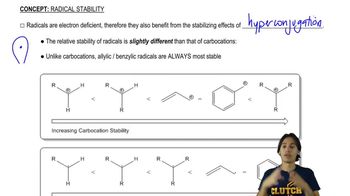
Radical Stability

In organic chemistry, the stability of radicals is crucial for understanding reaction mechanisms. Toluene, with its methyl group, stabilizes the radical formed during bromination through hyperconjugation and inductive effects. This stabilization makes the radical on the substituent carbon more favorable for reaction compared to other positions.
Video consigliato:
03:43
The radical stability trend.

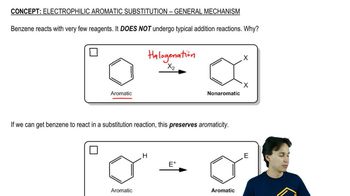
Selectivity in Electrophilic Aromatic Substitution

Electrophilic aromatic substitution (EAS) reactions, such as bromination, exhibit regioselectivity based on the nature of substituents on the aromatic ring. The methyl group in toluene is an electron-donating group, which directs electrophiles to the ortho and para positions, making the substituent carbon the most reactive site for radical attack.
Video consigliato:
03:07
EAS Review

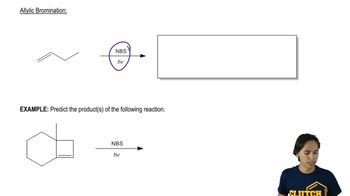
Bromination Mechanism

The bromination of toluene involves a radical mechanism where bromine (Br₂) dissociates into bromine radicals. In the second propagation step, the generated radical preferentially attacks the carbon atom adjacent to the methyl group due to the increased stability of the resulting radical, leading to a more favorable reaction pathway.
Video consigliato:
00:54
Mechanism of Allylic Bromination.