Ch. 3 - Alkanes and Cycloalkanes: Properties and Conformational Analysis
Mullins - Organic Chemistry: A Learner Centered Approach 1st Edition
Mullins1st EditionOrganic Chemistry: A Learner Centered ApproachISBN: 9780137566471Non è quello che usi tu?Cambia libro di testo
Capitolo 2, Problema 63

In contrast to ethane and other alkanes studied in this chapter, there is no free rotation around any bonds in cyclopentane (shown below). Why?

Guida verificata passo dopo passo
1
Cyclopentane is a cyclic compound, meaning its carbon atoms are arranged in a ring structure. This ring structure imposes geometric constraints on the molecule.
In cyclopentane, the carbon-carbon single bonds are part of the ring, and the ring structure restricts the ability of these bonds to freely rotate. This is because rotation would disrupt the ring's stability and geometry.
The lack of free rotation is due to the ring strain and the need to maintain the specific bond angles and spatial arrangement required for the ring to exist. Cyclopentane adopts a puckered conformation to minimize strain, further limiting bond rotation.
In contrast, alkanes like ethane have linear or branched structures without the geometric constraints of a ring, allowing free rotation around their carbon-carbon single bonds.
Thus, the cyclic nature of cyclopentane and the associated ring strain are the primary reasons why there is no free rotation around its bonds.

Risposta video verificata per un problema simile:

Questa soluzione video è stata consigliata dai nostri tutor come utile per risolvere questo problema.

Concetti chiave

Ecco i concetti essenziali che devi comprendere per rispondere correttamente alla domanda.

Cyclic Structures

Cyclic structures, such as cyclopentane, are closed-loop molecules where carbon atoms form a ring. This configuration can restrict the rotation around certain bonds due to steric hindrance and angle strain, which contrasts with linear alkanes like ethane that allow free rotation around their carbon-carbon bonds.
Video consigliato:
06:23
Monosaccharides - Forming Cyclic Hemiacetals

Bond Rotation and Conformation

In organic chemistry, bond rotation refers to the ability of atoms connected by a single bond to rotate freely around that bond. In cyclopentane, the presence of a ring structure limits this rotation, leading to specific conformations that minimize steric clashes between hydrogen atoms, thus affecting the molecule's stability and reactivity.
Video consigliato:
03:29
Understanding what a conformer is.

Angle Strain

Angle strain occurs when bond angles deviate from their ideal values, causing increased energy and instability in a molecule. In cyclopentane, the ideal tetrahedral angle is 109.5 degrees, but the ring structure can lead to angles that are less than ideal, contributing to the lack of free rotation and influencing the overall properties of the compound.
Video consigliato:
02:46
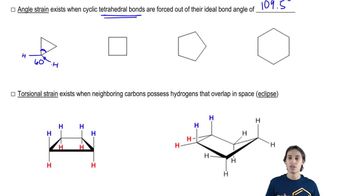
What is angle strain?
Pratica correlata
Domanda del libro di testo

Calculate the energy difference between each pair of conformations shown by drawing and comparing Newman projections down the indicated bonds in each.

(b)

1229
views

Domanda del libro di testo

In Chapter 5, we introduce reaction coordinate diagrams as a plot of potential energy versus the progress of a reaction. Consider the reaction coordinate diagram drawn for the 'reaction' of conformation A becoming conformation B. Which structure is present at the top of the hill?

<IMAGE>

1136
views
Domanda del libro di testo

For each structure shown, draw the two chair conformations and choose which is most stable. Be sure that your second chair is the flipped version of the first. [Make sure that wedged substituents are up in the chair, regardless of whether up is equatorial or axial.]

(g)

1247
views
Domanda del libro di testo

Looking ahead In Chapter 5, we explain that the equilibrium constant (Keq) for a reaction can be calculated based on the difference in energy between reactants and products, according to the following equation:

Keq=e−ΔERTK_{eq}=e^{-\(\frac{\Delta E}{RT}\)}

Using this equation, calculate the equilibrium constant for the 'reaction' shown. [For the rest of the book, if not otherwise specified, assume room temperature (298K).]

1295
views
1
rank
Domanda del libro di testo

For each structure shown, draw the two chair conformations and choose which is most stable. Be sure that your second chair is the flipped version of the first. [Make sure that wedged substituents are up in the chair, regardless of whether up is equatorial or axial.]

(e)

1557
views
Domanda del libro di testo

The normal C(sp3)–C(sp3) bond length is 1.54 Å. The normal bond angle for an sp3-hybridized carbon is 109.5°. The following molecule experiences large deviations from these normal values. Explain these deviations. [Molecular models would be helpful here.]

1001
views