Ch. 4 - Acids and Bases/Electron Flow
Mullins - Organic Chemistry: A Learner Centered Approach 1st Edition
Mullins1st EditionOrganic Chemistry: A Learner Centered ApproachISBN: 9780137566471Non è quello che usi tu?Cambia libro di testo
Capitolo 3, Problema 62f(iii,iv)

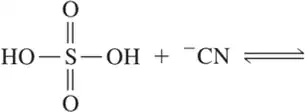
For the following acid–base pairs, (iii) predict the favored side of equilibrium; (iv) calculate ;
(f) Chemical equation illustrating an acid-base reaction with equilibrium representation.

Guida verificata passo dopo passo
1
Step 1: Identify the acid and base on both sides of the equilibrium. For each pair, determine which species donates a proton (acid) and which accepts a proton (base).
Step 2: Use the pKa values of the acids on both sides of the equilibrium. Recall that the strength of an acid is inversely related to its pKa value: a lower pKa indicates a stronger acid.
Step 3: Predict the favored side of the equilibrium. The equilibrium will favor the side with the weaker acid and weaker base. Compare the pKa values of the acids on both sides to determine this.
Step 4: Calculate the equilibrium constant (K_eq) using the relationship between the pKa values of the acids: \( \text{K}_\text{eq} = 10^{\text{pKa (acid on left)} - \text{pKa (acid on right)}} \).
Step 5: Interpret the result. If \( \text{K}_\text{eq} > 1 \), the equilibrium favors the products. If \( \text{K}_\text{eq} < 1 \), the equilibrium favors the reactants.

Risposta video verificata per un problema simile:

Questa soluzione video è stata consigliata dai nostri tutor come utile per risolvere questo problema.
Durata del video:
2m

Concetti chiave

Ecco i concetti essenziali che devi comprendere per rispondere correttamente alla domanda.

Acid-Base Theory

Acid-base theory explains the behavior of acids and bases in chemical reactions. According to the Brønsted-Lowry theory, acids are proton donors while bases are proton acceptors. Understanding this concept is crucial for predicting the direction of equilibrium in acid-base reactions, as the stronger acid will favor the formation of the weaker acid and base.
Video consigliato:
02:49
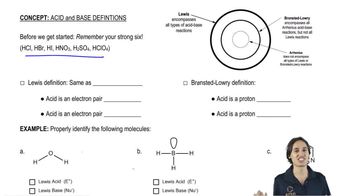
The Lewis definition of acids and bases.

Equilibrium Constant (K)

The equilibrium constant (K) quantifies the ratio of the concentrations of products to reactants at equilibrium for a given reaction. It provides insight into the position of equilibrium; a larger K value indicates that products are favored, while a smaller K suggests that reactants are favored. Calculating K is essential for determining the favored side of an acid-base equilibrium.
Video consigliato:
02:19
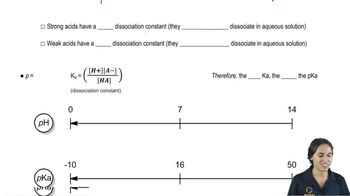
The relationship between equilibrium constant and pKa.

pKa and pKb Values

pKa and pKb values are measures of the strength of acids and bases, respectively. The pKa value indicates the acidity of a compound, with lower values signifying stronger acids, while pKb indicates basicity, with lower values signifying stronger bases. These values are critical for predicting the favored side of equilibrium, as they allow for comparison between the strengths of the acids and bases involved.
Video consigliato:
07:45
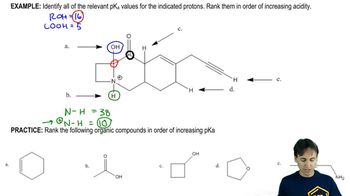
Identifying pKa values