Ch. 4 - Acids and Bases/Electron Flow
Mullins - Organic Chemistry: A Learner Centered Approach 1st Edition
Mullins1st EditionOrganic Chemistry: A Learner Centered ApproachISBN: 9780137566471Non è quello che usi tu?Cambia libro di testo
Capitolo 3, Problema 72d

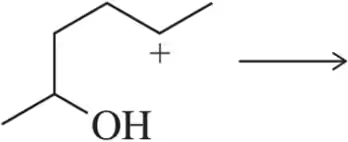
Predict the product of the following Lewis acid–Lewis base reactions.
(d) [an intramolecular reaction]
Lewis acid-base reaction diagram showing a hydroxyl group and a positive charge leading to a predicted product.

Guida verificata passo dopo passo
1
Step 1: Identify the Lewis acid and Lewis base in the reaction. In this case, the positively charged carbon atom (carbocation) is the Lewis acid, and the hydroxyl group (-OH) is the Lewis base.
Step 2: Recall that a Lewis acid is an electron pair acceptor, while a Lewis base is an electron pair donor. The hydroxyl group (-OH) has lone pairs of electrons on the oxygen atom, which can be donated to the carbocation.
Step 3: Predict the interaction between the Lewis acid and Lewis base. The lone pair of electrons from the oxygen atom in the hydroxyl group will form a bond with the carbocation, resulting in a new covalent bond.
Step 4: Consider the structure of the product. The oxygen atom from the hydroxyl group will now be directly bonded to the carbon atom that was previously the carbocation. This forms a new ether-like structure.
Step 5: Ensure the product is stable. Verify that all atoms in the product have complete octets and that the formal charges are minimized. The oxygen atom will likely retain a positive charge due to the bonding interaction.

Risposta video verificata per un problema simile:

Questa soluzione video è stata consigliata dai nostri tutor come utile per risolvere questo problema.
Durata del video:
2m

Concetti chiave

Ecco i concetti essenziali che devi comprendere per rispondere correttamente alla domanda.

Lewis Acids and Bases

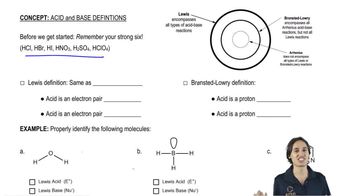
Lewis acids are electron pair acceptors, while Lewis bases are electron pair donors. In a Lewis acid-base reaction, the base donates an electron pair to the acid, forming a coordinate covalent bond. Understanding this concept is crucial for predicting the products of reactions involving these species, as it determines how they interact and the resulting molecular structures.
Video consigliato:
02:49
The Lewis definition of acids and bases.

Resonance Structures

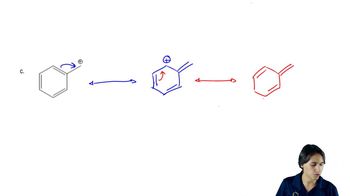
Resonance structures are different ways of drawing the same molecule that illustrate the delocalization of electrons. In the context of Lewis acid-base reactions, recognizing resonance can help predict the stability of intermediates and products. This is particularly important when dealing with charged species, as resonance can stabilize positive or negative charges, influencing the reaction pathway.
Video consigliato:
03:04
Drawing Resonance Structures

Nucleophilicity and Electrophilicity

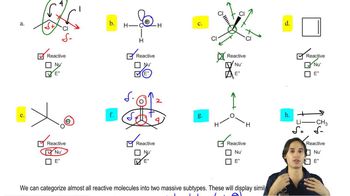
Nucleophilicity refers to the ability of a species to donate an electron pair, while electrophilicity refers to the ability of a species to accept an electron pair. In the given reaction, the hydroxyl group (OH) acts as a nucleophile due to its lone pairs, while the positively charged site acts as an electrophile. Understanding these properties is essential for predicting the direction and outcome of the reaction.
Video consigliato:
03:
Nucleophile or Electrophile