Ch. 4 - Acids and Bases/Electron Flow
Mullins - Organic Chemistry: A Learner Centered Approach 1st Edition
Mullins1st EditionOrganic Chemistry: A Learner Centered ApproachISBN: 9780137566471Non è quello che usi tu?Cambia libro di testo
Capitolo 3, Problema 74

One of the more reactive species we will study in organic chemistry is the carbene (molecular formula of CH2). The carbene can react as both a Lewis acid and a Lewis base. Explain these properties.

Guida verificata passo dopo passo
1
Understand the concept of a carbene: A carbene is a reactive intermediate with the general formula R₂C, where R can be hydrogen or other substituents. It contains a carbon atom with only six valence electrons, making it electron-deficient and highly reactive.
Explain the Lewis acid behavior: A Lewis acid is a species that can accept a pair of electrons. The carbene has an empty p orbital due to its electron deficiency, which allows it to act as a Lewis acid by accepting electron pairs from nucleophiles.
Explain the Lewis base behavior: A Lewis base is a species that can donate a pair of electrons. The carbene also has a lone pair of electrons on the carbon atom, which can be donated to electrophiles, allowing it to act as a Lewis base.
Discuss the dual reactivity: The ability of the carbene to act as both a Lewis acid and a Lewis base arises from its unique electronic structure—having both an empty orbital and a lone pair of electrons. This dual reactivity makes carbenes versatile intermediates in organic reactions.
Provide examples of reactions: Carbenes can participate in reactions such as cyclopropanation (acting as a Lewis base) or insertion into bonds (acting as a Lewis acid). These reactions highlight the importance of understanding their dual nature in organic chemistry.

Risposta video verificata per un problema simile:

Questa soluzione video è stata consigliata dai nostri tutor come utile per risolvere questo problema.

Concetti chiave

Ecco i concetti essenziali che devi comprendere per rispondere correttamente alla domanda.

Carbene Structure and Reactivity

Carbenes are neutral species containing a carbon atom with only six valence electrons, making them highly reactive. They exist in two forms: singlet, where the two non-bonding electrons are paired, and triplet, where they are unpaired. This unique electronic configuration allows carbenes to participate in various chemical reactions, often acting as intermediates in organic synthesis.
Video consigliato:
01:48
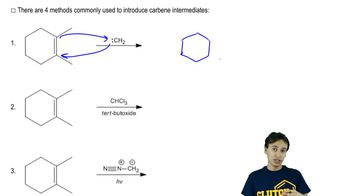
Reaction with a simple carbene.

Lewis Acids and Bases

According to Lewis theory, a Lewis acid is an electron pair acceptor, while a Lewis base is an electron pair donor. Carbenes can exhibit both behaviors due to their electron-deficient nature, allowing them to accept electron pairs from Lewis bases or donate their lone pair of electrons to Lewis acids. This duality is crucial for understanding their reactivity in organic reactions.
Video consigliato:
02:49
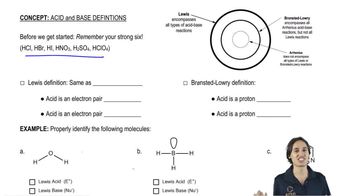
The Lewis definition of acids and bases.

Reactivity of Carbenes in Organic Reactions

Carbenes participate in various organic reactions, such as insertion into C-H bonds, cyclopropanation, and addition to alkenes. Their ability to act as both Lewis acids and bases enables them to form new bonds and stabilize reaction intermediates. Understanding these reactivity patterns is essential for predicting the outcomes of reactions involving carbenes in organic synthesis.
Video consigliato:
01:48
Reaction with a simple carbene.