Ch. 8 - Alkenes 1: Properties and Electrophilic Additions
Mullins - Organic Chemistry: A Learner Centered Approach 1st Edition
Mullins1st EditionOrganic Chemistry: A Learner Centered ApproachISBN: 9780137566471Non è quello che usi tu?Cambia libro di testo
Capitolo 7, Problema 8

Draw the molecular orbital picture of trans-but-2-ene.
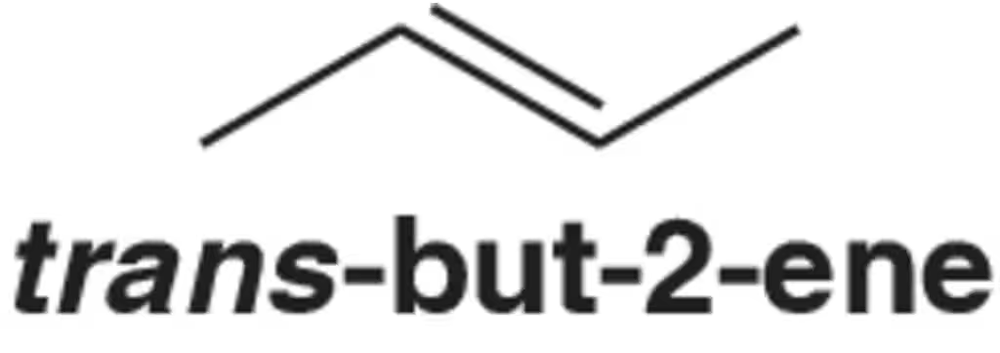
Molecular structure diagram of trans-but-2-ene with the name labeled below.

Guida verificata passo dopo passo
1
Start by identifying the molecular structure of trans-but-2-ene. It is a four-carbon alkene with a double bond between carbons 2 and 3, and the two substituents on the double-bonded carbons are on opposite sides (trans configuration).
Determine the type of orbitals involved in the bonding. The double bond consists of one sigma (σ) bond formed by the overlap of sp² hybrid orbitals and one pi (π) bond formed by the side-by-side overlap of unhybridized p orbitals.
Draw the sigma framework first. Each carbon atom in the molecule is sp² hybridized, so three sp² orbitals on each carbon form sigma bonds: one with a hydrogen atom, one with another carbon atom, and one with the adjacent carbon in the double bond.
Next, represent the pi bond. The unhybridized p orbitals on carbons 2 and 3 overlap laterally to form the π bond. Ensure that the p orbitals are shown perpendicular to the plane of the molecule, as this is a key feature of π bonding.
Finally, label the molecular orbitals. The bonding molecular orbital (π) is formed by the in-phase overlap of the p orbitals, while the antibonding molecular orbital (π*) is formed by the out-of-phase overlap. Indicate the relative energy levels of these orbitals, with π being lower in energy than π*.

Risposta video verificata per un problema simile:

Questa soluzione video è stata consigliata dai nostri tutor come utile per risolvere questo problema.
Durata del video:
2m

Concetti chiave

Ecco i concetti essenziali che devi comprendere per rispondere correttamente alla domanda.

Molecular Orbitals

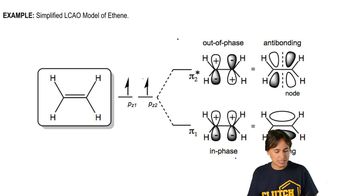
Molecular orbitals (MOs) are formed by the combination of atomic orbitals when atoms bond together. In the case of trans-but-2-ene, the MOs help describe the distribution of electrons in the molecule, which influences its stability and reactivity. Understanding how these orbitals overlap is crucial for visualizing the bonding and electronic structure of the compound.
Video consigliato:
08:41
Review of Molecular Orbitals

Trans Configuration

Trans configuration refers to the arrangement of substituents across a double bond in a molecule. For trans-but-2-ene, the two methyl groups are positioned on opposite sides of the double bond, which affects the molecule's physical properties, such as boiling point and polarity. Recognizing this configuration is essential for accurately drawing its molecular orbital picture.
Video consigliato:
02:14
The Electron Configuration

Hybridization

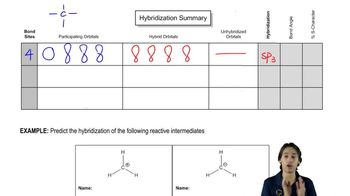
Hybridization is the concept of mixing atomic orbitals to form new hybrid orbitals that can accommodate bonding. In trans-but-2-ene, the carbon atoms undergo sp² hybridization, resulting in three sp² hybrid orbitals for sigma bonding and one unhybridized p orbital for pi bonding. This understanding is vital for constructing the molecular orbital diagram and predicting the molecule's geometry.
Video consigliato:
10:43
Using bond sites to predict hybridization