Ch. 8 - Alkenes 1: Properties and Electrophilic Additions
Mullins - Organic Chemistry: A Learner Centered Approach 1st Edition
Mullins1st EditionOrganic Chemistry: A Learner Centered ApproachISBN: 9780137566471Non è quello che usi tu?Cambia libro di testo
Capitolo 7, Problema 53b

Oxymercuration–reduction, like acid-catalyzed hydration, can be modified to synthesize ethers. Suggest an alkene and the appropriate reaction conditions to synthesize the following ethers.
(b)

Guida verificata passo dopo passo
1
Identify the ether to be synthesized: The given structure is an ether with a cyclohexyl group, a methyl group, and an ethyl group attached to the oxygen atom.
Determine the alkene precursor: To form the ether, consider the alkene that would lead to the desired ether upon oxymercuration-reduction. The alkene should have a double bond where the oxygen will be added.
Select the appropriate alkene: In this case, the alkene could be 1-methylcyclohexene, which has a double bond between the cyclohexyl ring and the methyl group.
Choose the reaction conditions: Oxymercuration-reduction involves two main steps. First, treat the alkene with mercuric acetate (Hg(OAc)₂) in the presence of an alcohol (in this case, ethanol) to form the mercurinium ion intermediate. Then, reduce the intermediate using sodium borohydride (NaBH₄) to form the ether.
Explain the mechanism: During oxymercuration, the alkene reacts with Hg(OAc)₂ to form a mercurinium ion. The alcohol (ethanol) attacks the more substituted carbon, leading to the formation of an ether linkage. The reduction step with NaBH₄ removes the mercury, yielding the final ether product.

Risposta video verificata per un problema simile:

Questa soluzione video è stata consigliata dai nostri tutor come utile per risolvere questo problema.
Durata del video:
5m

Concetti chiave

Ecco i concetti essenziali che devi comprendere per rispondere correttamente alla domanda.

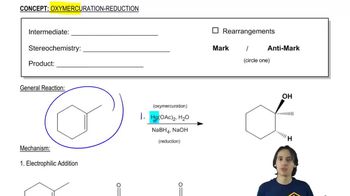
Oxymercuration-Reduction

Oxymercuration-reduction is a two-step reaction used to convert alkenes into alcohols. The first step involves the addition of mercuric acetate to the alkene, forming a mercurial intermediate. In the second step, this intermediate is reduced, typically using sodium borohydride, to yield the corresponding alcohol. This method is advantageous because it proceeds via a Markovnikov addition, ensuring that the more substituted carbon receives the hydroxyl group.
Video consigliato:
05:
General properties of oxymercuration-reduction.

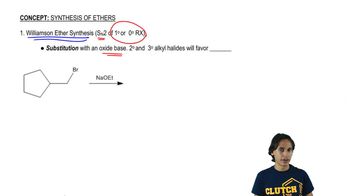
Ether Synthesis

Ethers can be synthesized through various methods, one of which involves the reaction of alcohols with alkyl halides or through the alkoxymercuration of alkenes. In the context of oxymercuration-reduction, the reaction can be modified to produce ethers by using an alcohol as a nucleophile instead of water. This results in the formation of an ether when the mercurial intermediate reacts with the alcohol, followed by reduction.
Video consigliato:
03:50
The Mechanism of Williamson Ether Synthesis.

Markovnikov's Rule

Markovnikov's Rule states that in the addition of HX to an alkene, the hydrogen atom will attach to the carbon with the greater number of hydrogen atoms already attached, while the halide (or hydroxyl group) will attach to the more substituted carbon. This principle is crucial in predicting the outcome of reactions involving alkenes, such as oxymercuration-reduction, as it guides the regioselectivity of product formation, ensuring the desired ether structure is achieved.
Video consigliato:
03:54
The 18 and 16 Electron Rule