Provide an arrow-pushing mechanism, accounting also for the stereochemical outcome, of the first step (oxymercuration) of the three reactions in Figure 8.63.
Ch. 8 - Alkenes 1: Properties and Electrophilic Additions

Mullins1st EditionOrganic Chemistry: A Learner Centered ApproachISBN: 9780137566471Non è quello che usi tu?Cambia libro di testo
Tutti i libri di testo
Mullins 1st Edition
Ch. 8 - Alkenes 1: Properties and Electrophilic Additions
Problema 53a
Mullins 1st Edition
Ch. 8 - Alkenes 1: Properties and Electrophilic Additions
Problema 53aCapitolo 7, Problema 53a
Oxymercuration–reduction, like acid-catalyzed hydration, can be modified to synthesize ethers. Suggest an alkene and the appropriate reaction conditions to synthesize the following ethers.
(a) 
Guida verificata passo dopo passo1
Identify the target ether structure and determine the position of the oxygen atom in the final product. This will help in identifying the alkene and the alcohol needed for the reaction.
Select an alkene that, upon oxymercuration, will lead to the formation of a carbocation at the position where the ether linkage is desired. This is typically the more substituted carbon of the double bond.
Choose the appropriate alcohol that will act as the nucleophile in the reaction. The alcohol will attack the carbocation formed during the oxymercuration step, leading to the formation of the ether linkage.
Set up the reaction conditions for oxymercuration. This typically involves using mercuric acetate (Hg(OAc)2) in a solvent like THF (tetrahydrofuran) with the chosen alcohol. This step forms the mercurinium ion intermediate.
Perform the reduction step using sodium borohydride (NaBH4) in a basic aqueous solution. This step will remove the mercury group and complete the formation of the ether product.

Risposta video verificata per un problema simile:
Questa soluzione video è stata consigliata dai nostri tutor come utile per risolvere questo problema.
Durata del video:
2mConcetti chiave
Ecco i concetti essenziali che devi comprendere per rispondere correttamente alla domanda.
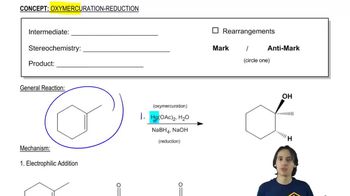
Oxymercuration–Reduction
Oxymercuration–reduction is a two-step reaction used to convert alkenes into alcohols or ethers without carbocation rearrangement. The first step involves the addition of mercuric acetate to the alkene, forming a mercurinium ion intermediate. In the second step, sodium borohydride (NaBH4) reduces the intermediate, replacing the mercury with a hydrogen atom, resulting in the formation of an alcohol or ether.
Video consigliato:
General properties of oxymercuration-reduction.
Alkene Selection
Choosing the correct alkene is crucial for synthesizing the desired ether. The alkene's structure determines the position where the ether linkage will form. Typically, the alkene should have a double bond at the location where the ether's oxygen will be introduced, ensuring the correct regioselectivity and stereochemistry in the final product.
Video consigliato:
Percorso guidato
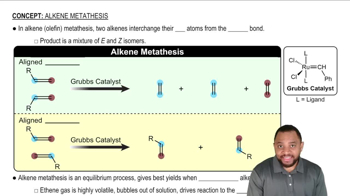
Alkene Metathesis Concept 1
Reaction Conditions for Ether Synthesis
To synthesize ethers using oxymercuration–reduction, the reaction conditions must be carefully controlled. The process involves using an alcohol as a nucleophile instead of water in the oxymercuration step. This modification allows the formation of an ether linkage instead of an alcohol, with the alcohol's oxygen attacking the mercurinium ion, leading to the desired ether product after reduction.
Video consigliato:
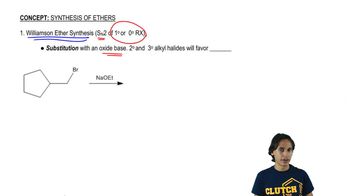
The Mechanism of Williamson Ether Synthesis.
Pratica correlata
Domanda del libro di testo
1355
views
Domanda del libro di testo
Which is more stable, a carbocation or a mercurinium ion? How do you know?
1324
views
Domanda del libro di testo
Oxymercuration–reduction, like acid-catalyzed hydration, can be modified to synthesize ethers. Suggest an alkene and the appropriate reaction conditions to synthesize the following ethers.
(b)
1167
views
Domanda del libro di testo
Predict the products you would get when the following alkenes undergo (i) hydroboration–oxidation (1. BH3 2. NaOH, H2O2 or (ii) oxymercuration–reduction [1. Hg(OAc)2, H2O 2. NaBH4].
(a)
1186
views
Domanda del libro di testo
Predict the products you would get when the following alkenes undergo (ii) oxymercuration–reduction [1. Hg(OAc)2 , H2O 2. NaBH4 ].
(b)
1208
views
Domanda del libro di testo
Provide an arrow-pushing mechanism, accounting also for the stereochemical outcome, of the first step (oxymercuration) of the three reactions in Figure 8.63.
1278
views