Ch. 8 - Alkenes 1: Properties and Electrophilic Additions
Mullins - Organic Chemistry: A Learner Centered Approach 1st Edition
Mullins1st EditionOrganic Chemistry: A Learner Centered ApproachISBN: 9780137566471Non è quello che usi tu?Cambia libro di testo
Capitolo 7, Problema 46b

Provide a mechanism for the following reactions occurring with rearrangement.
(b)

Guida verificata passo dopo passo
1
Identify the starting material as a cyclopentene with two methyl groups attached to the ring. The reaction involves the addition of HBr, a common reagent for electrophilic addition reactions.
Recognize that the first step in the mechanism is the protonation of the alkene. The π electrons of the double bond will attack the hydrogen atom of HBr, leading to the formation of a carbocation intermediate.
Determine the most stable carbocation intermediate. In this case, the initial carbocation formed is secondary, but a rearrangement can occur to form a more stable tertiary carbocation. This involves a hydride shift from the adjacent carbon.
Once the tertiary carbocation is formed, the bromide ion (Br⁻) will attack the positively charged carbon, resulting in the formation of the final product with the bromine atom attached to the carbon where the carbocation was located.
Verify the final structure of the product, ensuring that the bromine is attached to the carbon that was part of the rearranged tertiary carbocation, and the overall structure matches the product shown in the image.

Risposta video verificata per un problema simile:

Questa soluzione video è stata consigliata dai nostri tutor come utile per risolvere questo problema.

Concetti chiave

Ecco i concetti essenziali che devi comprendere per rispondere correttamente alla domanda.

Reaction Mechanism

A reaction mechanism is a step-by-step description of the process by which reactants are converted into products. It outlines the individual steps, including bond breaking and formation, and the intermediates formed during the reaction. Understanding the mechanism is crucial for predicting the outcome of a reaction and for identifying the conditions that favor certain pathways.
Video consigliato:
02:16
Heck Reaction Mechanism

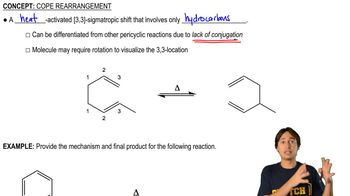
Rearrangement Reactions

Rearrangement reactions involve the structural reorganization of a molecule to form a new isomer. These reactions often occur through the migration of atoms or groups within the molecule, leading to different connectivity. Recognizing the types of rearrangements, such as hydride shifts or alkyl shifts, is essential for predicting the products of a reaction and understanding the stability of intermediates.
Video consigliato:
06:28
Definition of Cope Rearrangement

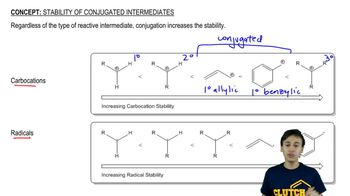
Intermediates

Intermediates are transient species that form during the course of a chemical reaction but are not present in the final products. They can be stable or unstable and play a critical role in determining the pathway and rate of the reaction. Identifying intermediates helps in understanding the mechanism and can provide insight into how rearrangements occur during the reaction.
Video consigliato:
04:31
Stability of Conjugated Intermediates