Ch. 8 - Alkenes 1: Properties and Electrophilic Additions
Mullins - Organic Chemistry: A Learner Centered Approach 1st Edition
Mullins1st EditionOrganic Chemistry: A Learner Centered ApproachISBN: 9780137566471Non è quello che usi tu?Cambia libro di testo
Capitolo 7, Problema 47

The hydration of three C5H10 alkene isomers can give 2-methylbutan-2-ol. Draw them.

Guida verificata passo dopo passo
1
Identify the target product, 2-methylbutan-2-ol, and recognize that it is a tertiary alcohol. This means the hydroxyl group (-OH) is attached to a carbon atom that is bonded to three other carbon atoms.
Understand that the hydration of an alkene involves the addition of water (H₂O) across the double bond, following Markovnikov's rule. This rule states that the -OH group will attach to the more substituted carbon of the double bond.
Determine the possible structures of C₅H₁₀ alkenes that can lead to 2-methylbutan-2-ol. These alkenes must have a double bond positioned such that, upon hydration, the -OH group attaches to the tertiary carbon in the final product.
Draw the first isomer: 2-methylbut-2-ene. This structure has the double bond between the second and third carbons, and the methyl group is attached to the second carbon. Hydration of this alkene will directly yield 2-methylbutan-2-ol.
Draw the second and third isomers: 3-methylbut-1-ene and 2-methylbut-1-ene. In these cases, the double bond is positioned differently, but hydration will still lead to the formation of 2-methylbutan-2-ol due to carbocation rearrangement during the reaction mechanism.

Risposta video verificata per un problema simile:

Questa soluzione video è stata consigliata dai nostri tutor come utile per risolvere questo problema.
Durata del video:
3m

Concetti chiave

Ecco i concetti essenziali che devi comprendere per rispondere correttamente alla domanda.

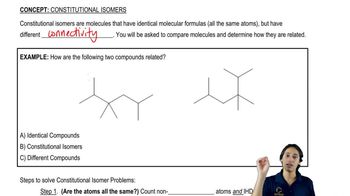
Alkene Isomers

Alkene isomers are compounds that have the same molecular formula but differ in the arrangement of their carbon atoms or the position of their double bonds. In the case of C₅H₁₀, there are several structural isomers, including those with different branching patterns. Understanding these isomers is crucial for predicting the products of reactions such as hydration.
Video consigliato:
01:10
What is a constitutional isomer?

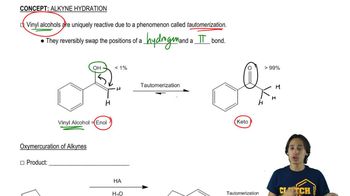
Hydration Reaction

Hydration is a chemical reaction where water is added to an alkene, resulting in the formation of an alcohol. This reaction typically follows Markovnikov's rule, where the hydrogen atom from water adds to the carbon with the most hydrogen substituents, leading to the formation of more stable carbocation intermediates. Recognizing how hydration affects the structure of the resulting alcohol is essential for this question.
Video consigliato:
09:11
Alkyne Hydration

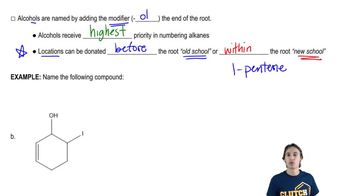
2-Methylbutan-2-ol

2-Methylbutan-2-ol is a specific alcohol that can be formed from the hydration of certain C₅H₁₀ alkene isomers. It features a secondary alcohol structure with a methyl group on the second carbon of a butane chain. Identifying the alkene isomers that can yield this particular alcohol through hydration is key to solving the question.
Video consigliato:
03:03
Old school vs. new school naming