Ch. 8 - Alkenes 1: Properties and Electrophilic Additions
Mullins - Organic Chemistry: A Learner Centered Approach 1st Edition
Mullins1st EditionOrganic Chemistry: A Learner Centered ApproachISBN: 9780137566471Non è quello che usi tu?Cambia libro di testo
Capitolo 7, Problema 51

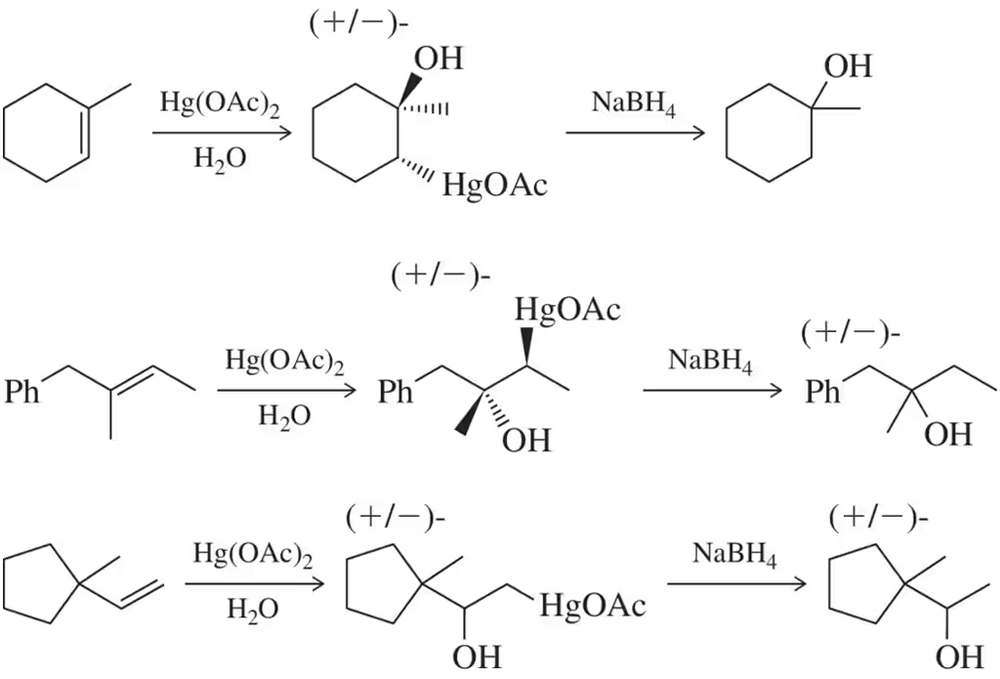
Provide an arrow-pushing mechanism, accounting also for the stereochemical outcome, of the first step (oxymercuration) of the three reactions in Figure 8.63.
Arrow-pushing mechanism for oxymercuration, showing stereochemical outcomes in three reactions with Hg(OAc)2 and NaBH4.

Guida verificata passo dopo passo
1
Begin by identifying the alkene substrate involved in the oxymercuration reaction. The alkene will undergo electrophilic addition, where the π bond acts as a nucleophile.
In the oxymercuration step, the alkene reacts with mercuric acetate (Hg(OAc)₂). The π electrons of the alkene attack the mercury atom, forming a mercurinium ion intermediate. Use curved arrows to show the movement of electrons from the π bond to the mercury atom.
The mercurinium ion is a cyclic intermediate where the mercury atom is bonded to both carbons of the former double bond. This intermediate is crucial for understanding the stereochemical outcome, as it dictates the regioselectivity of the subsequent nucleophilic attack.
Next, consider the nucleophilic attack by water (H₂O) on the more substituted carbon of the mercurinium ion. This attack opens the ring and leads to the formation of an organomercury alcohol. Use curved arrows to show the movement of electrons from the water molecule to the more substituted carbon.
Finally, account for the stereochemical outcome. The nucleophilic attack occurs from the side opposite to the mercury atom, leading to anti addition. This results in the formation of a trans product, where the hydroxyl group and the mercury acetate group are on opposite sides of the former double bond.

Risposta video verificata per un problema simile:

Questa soluzione video è stata consigliata dai nostri tutor come utile per risolvere questo problema.
Durata del video:
6m

Concetti chiave

Ecco i concetti essenziali che devi comprendere per rispondere correttamente alla domanda.

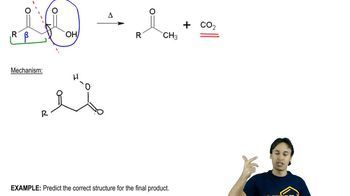
Arrow-Pushing Mechanism

Arrow-pushing is a technique used in organic chemistry to depict the movement of electrons during chemical reactions. It involves using curved arrows to show how electron pairs move from nucleophiles to electrophiles, helping to visualize the step-by-step transformation of reactants into products. Understanding this concept is crucial for predicting reaction pathways and outcomes.
Video consigliato:
04:32
General Mechanism

Oxymercuration Reaction

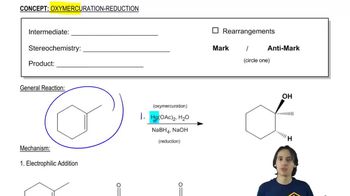
Oxymercuration is a chemical reaction that involves the addition of mercury(II) acetate to an alkene, followed by nucleophilic attack by water, resulting in the formation of an alcohol. This reaction proceeds via a cyclic mercurinium ion intermediate, which is key to understanding the stereochemical aspects of the reaction. It is important for synthesizing alcohols with Markovnikov regioselectivity without carbocation rearrangement.
Video consigliato:
05:
General properties of oxymercuration-reduction.

Stereochemical Outcome

Stereochemistry refers to the spatial arrangement of atoms in molecules and its impact on chemical reactions. In oxymercuration, the stereochemical outcome is influenced by the formation of the mercurinium ion, which dictates the orientation of the nucleophilic attack. Understanding stereochemistry is essential for predicting the configuration of the final product, which can affect its physical and chemical properties.
Video consigliato:
Percorso guidato
1:19
Peptide Sequencing: Partial Hydrolysis Concept 1