Ch. 9 - Alkenes 2: Oxidation and Reduction
Mullins - Organic Chemistry: A Learner Centered Approach 1st Edition
Mullins1st EditionOrganic Chemistry: A Learner Centered ApproachISBN: 9780137566471Non è quello che usi tu?Cambia libro di testo
Capitolo 8, Problema 14

How does the carbonyl in mCPBA weaken the O―O σ bond (i.e., make a better leaving group)?

Guida verificata passo dopo passo
1
The O―O σ bond in peroxides, such as hydrogen peroxide (HO―OH), is inherently weak due to the repulsion between the lone pairs on the adjacent oxygen atoms. This bond can be further weakened by electronic effects from substituents.
In mCPBA (meta-chloroperoxybenzoic acid), the carbonyl group (C=O) is highly electronegative and withdraws electron density from the adjacent oxygen atoms through resonance and inductive effects.
The electron-withdrawing nature of the carbonyl group stabilizes the negative charge on the leaving group (the oxygen atom) when the O―O bond breaks, making the bond easier to cleave.
Additionally, the resonance structure of mCPBA allows delocalization of electrons from the carbonyl group, further reducing electron density on the O―O bond and weakening it.
The presence of the aromatic ring and the chlorine substituent in mCPBA also contributes to the electron-withdrawing effects, enhancing the ability of the O―O bond to act as a better leaving group compared to hydrogen peroxide.

Risposta video verificata per un problema simile:

Questa soluzione video è stata consigliata dai nostri tutor come utile per risolvere questo problema.

Concetti chiave

Ecco i concetti essenziali che devi comprendere per rispondere correttamente alla domanda.

Carbonyl Group Reactivity

The carbonyl group (C=O) is highly polar, with a partial positive charge on the carbon atom and a partial negative charge on the oxygen. This polarity makes the carbonyl carbon susceptible to nucleophilic attack, which can lead to the formation of more reactive intermediates. In the context of mCPBA, the carbonyl's reactivity plays a crucial role in facilitating the weakening of the O―O bond.
Video consigliato:
03:50
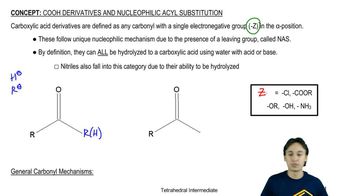
Intro to Carboxylic Acid Derivatives

Peroxide Bond Strength

The O―O bond in peroxides, such as mCPBA, is relatively weak compared to other covalent bonds. This weakness is due to the repulsion between the lone pairs of electrons on the oxygen atoms. When the carbonyl group interacts with the peroxide, it can stabilize the transition state, leading to a decrease in the O―O bond strength and making it a better leaving group during reactions.
Video consigliato:
06:00
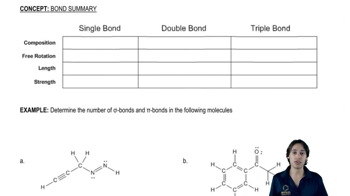
Single bonds, double bonds, and triple bonds.

Leaving Group Ability

A leaving group is an atom or group that can depart from the parent molecule during a chemical reaction, often taking with it a pair of electrons. The ability of a leaving group to depart is influenced by its stability after leaving. In the case of mCPBA, the weakening of the O―O bond enhances the leaving group's ability, as the resulting species can be more stable, thus facilitating the overall reaction.
Video consigliato:
03:06
How to use the factors affecting acidity to predict leaving group ability.