

Ch. 9 - Alkenes 2: Oxidation and Reduction
Mullins - Organic Chemistry: A Learner Centered Approach 1st Edition
Mullins1st EditionOrganic Chemistry: A Learner Centered ApproachISBN: 9780137566471Non è quello che usi tu?Cambia libro di testo
Capitolo 8, Problema 16a

Predict the product(s) when each of the following are reacted with mCPBA, making sure to indicate the relative stereochemical outcome. Indicate any racemic mixtures by drawing both enantiomers.
(a) Chemical structure of a phenyl-substituted alkene with two phenyl groups attached to a double bond.

Guida verificata passo dopo passo
1
Understand the reagent: mCPBA (meta-chloroperoxybenzoic acid) is a peracid commonly used for epoxidation of alkenes. It adds an oxygen atom across the double bond to form an epoxide (a three-membered cyclic ether).
Analyze the substrate: Identify the alkene in the given molecule. The double bond is the reactive site where mCPBA will act to form the epoxide.
Determine the stereochemical outcome: The epoxidation reaction with mCPBA is stereospecific. If the alkene is cis (Z-configuration), the epoxide will retain the cis stereochemistry. If the alkene is trans (E-configuration), the epoxide will retain the trans stereochemistry.
Account for chirality: If the alkene is part of a chiral molecule or generates a chiral center upon epoxidation, consider the possibility of forming enantiomers. If the starting material is achiral, the product will be a racemic mixture of enantiomers.
Draw the product(s): Represent the epoxide product(s) with the correct stereochemistry. If a racemic mixture is formed, draw both enantiomers explicitly to indicate the outcome.

Risposta video verificata per un problema simile:

Questa soluzione video è stata consigliata dai nostri tutor come utile per risolvere questo problema.
Durata del video:
3m

Concetti chiave

Ecco i concetti essenziali che devi comprendere per rispondere correttamente alla domanda.

mCPBA and its Role in Organic Reactions

mCPBA, or meta-chloroperbenzoic acid, is a peracid commonly used in organic chemistry for the epoxidation of alkenes. It introduces an oxygen atom across the double bond, forming an epoxide, which is a three-membered cyclic ether. Understanding how mCPBA reacts with different substrates is crucial for predicting the products of these reactions.
Video consigliato:
00:29
What you need to know about types of chemical reactions.

Stereochemistry and Epoxide Formation

Stereochemistry refers to the spatial arrangement of atoms in molecules and how this affects their chemical behavior. When mCPBA reacts with alkenes, the stereochemical outcome of the epoxide can lead to different configurations (cis or trans) based on the starting alkene's geometry. Recognizing how stereochemistry influences the formation of products is essential for predicting the relative stereochemical outcomes.
Video consigliato:
Percorso guidato
1:38
Polymer Stereochemistry Concept 1

Enantiomers and Racemic Mixtures

Enantiomers are pairs of molecules that are non-superimposable mirror images of each other, often resulting from chiral centers in a compound. When a reaction produces both enantiomers in equal amounts, it is termed a racemic mixture. Identifying and representing racemic mixtures is important in organic synthesis, especially when discussing the stereochemical outcomes of reactions involving chiral products.
Video consigliato:
03:08
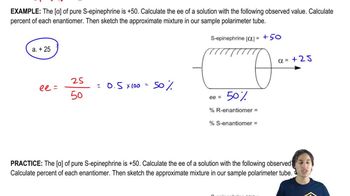
Calculating EE, percent of each enantiomer, and sketching mixture