
Ch. 9 - Alkenes 2: Oxidation and Reduction
Mullins - Organic Chemistry: A Learner Centered Approach 1st Edition
Mullins1st EditionOrganic Chemistry: A Learner Centered ApproachISBN: 9780137566471Non è quello che usi tu?Cambia libro di testo
Capitolo 8, Problema 16d

Predict the product(s) when each of the following are reacted with mCPBA, making sure to indicate the relative stereochemical outcome. Indicate any racemic mixtures by drawing both enantiomers.
(d)

Guida verificata passo dopo passo
1
Step 1: Recognize that mCPBA (meta-chloroperoxybenzoic acid) is a reagent commonly used for epoxidation of alkenes. It reacts with the double bond in the molecule to form an epoxide.
Step 2: Identify the alkene in the given structure. The double bond is located in the chain, and this is the site where the epoxidation will occur.
Step 3: Understand the stereochemical implications of the reaction. Epoxidation with mCPBA is stereospecific and proceeds via a concerted mechanism, preserving the stereochemistry of the substituents on the double bond.
Step 4: Draw the product of the reaction. The epoxide will form across the double bond, and the stereochemistry of the substituents on the double bond will determine the configuration of the epoxide. If the substituents are not stereospecific, a racemic mixture of enantiomers will result.
Step 5: Indicate the relative stereochemical outcome. If the starting alkene is planar and does not have stereochemical constraints, both enantiomers of the epoxide should be drawn to represent the racemic mixture.

Risposta video verificata per un problema simile:

Questa soluzione video è stata consigliata dai nostri tutor come utile per risolvere questo problema.

Concetti chiave

Ecco i concetti essenziali che devi comprendere per rispondere correttamente alla domanda.

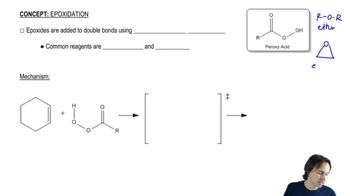
mCPBA and Epoxidation

mCPBA (meta-Chloroperbenzoic acid) is a common reagent used in organic chemistry for the epoxidation of alkenes. This reaction involves the formation of a three-membered cyclic ether called an epoxide, which is characterized by its strained ring structure. The reaction typically proceeds via a concerted mechanism, where the alkene reacts with mCPBA to form the epoxide without any intermediates.
Video consigliato:
02:19
General properties of epoxidation.

Stereochemistry of Epoxidation

The stereochemical outcome of epoxidation is crucial, as it can lead to the formation of chiral centers. When an alkene is epoxidized, the stereochemistry of the starting alkene influences the configuration of the resulting epoxide. If the alkene is asymmetric, the reaction can produce enantiomers, leading to racemic mixtures if both configurations are formed.
Video consigliato:
Percorso guidato
1:38
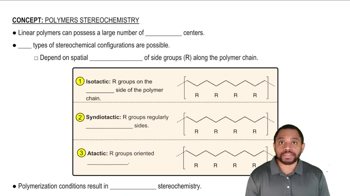
Polymer Stereochemistry Concept 1

Relative Stereochemistry and Enantiomers

Relative stereochemistry refers to the spatial arrangement of atoms in a molecule and how they relate to one another. In the context of epoxidation, understanding the relative stereochemistry is essential for predicting the products. Enantiomers are pairs of molecules that are non-superimposable mirror images of each other, and when a reaction produces both configurations, it results in a racemic mixture, which must be represented in product drawings.
Video consigliato:
Percorso guidato
1:38
Polymer Stereochemistry Concept 1