Ch. 9 - Alkenes 2: Oxidation and Reduction
Mullins - Organic Chemistry: A Learner Centered Approach 1st Edition
Mullins1st EditionOrganic Chemistry: A Learner Centered ApproachISBN: 9780137566471Non è quello che usi tu?Cambia libro di testo
Capitolo 8, Problema 17.8a

Predict the product of the following aldehyde/ketone syntheses.


(a) <IMAGE>

Guida verificata passo dopo passo
1
Identify the starting material in the synthesis. Determine if it is an aldehyde or a ketone based on the functional group present.
Examine the reagents and conditions provided in the synthesis. Common reagents for aldehyde/ketone synthesis include oxidizing agents, reducing agents, or organometallic reagents.
Consider the mechanism of the reaction. For example, if an oxidizing agent is used, an alcohol might be converted to an aldehyde or ketone. If a reducing agent is used, an aldehyde or ketone might be reduced to an alcohol.
Predict the structure of the product based on the reaction mechanism. Ensure that the functional group transformation aligns with the reagents and conditions used.
Verify the stereochemistry and regiochemistry of the product, if applicable, to ensure the predicted product is consistent with the expected outcome of the reaction.

Concetti chiave

Ecco i concetti essenziali che devi comprendere per rispondere correttamente alla domanda.

Aldehyde and Ketone Reactivity

Aldehydes and ketones are carbonyl compounds that exhibit distinct reactivity due to the presence of the carbonyl group (C=O). Aldehydes, with at least one hydrogen atom attached to the carbonyl carbon, are generally more reactive than ketones, which have two alkyl groups. Understanding their reactivity is crucial for predicting the products of reactions involving these compounds.
Video consigliato:
03:57
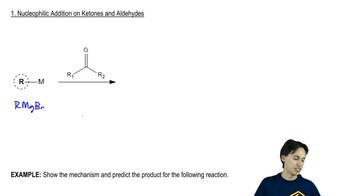
Nucleophilic Addition on Ketones and Aldehydes

Nucleophilic Addition Reactions

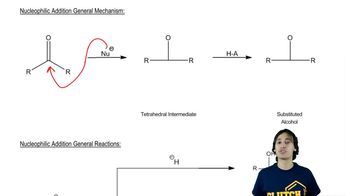
Nucleophilic addition is a fundamental reaction mechanism in organic chemistry where a nucleophile attacks the electrophilic carbon of a carbonyl group. This process leads to the formation of a tetrahedral intermediate, which can further react to yield various products, such as alcohols or other functional groups. Recognizing the nucleophiles involved is essential for predicting the outcome of aldehyde and ketone syntheses.
Video consigliato:
08:27
Nucleophilic Addition

Functional Group Transformations

Functional group transformations involve the conversion of one functional group into another through chemical reactions. In the context of aldehyde and ketone syntheses, understanding how to manipulate these groups—such as through oxidation, reduction, or substitution reactions—is vital for predicting the final products. Mastery of these transformations allows chemists to design synthetic pathways effectively.
Video consigliato:
02:36
Identifying Functional Groups