Ch.1 - Structure and Bonding
Wade - Organic Chemistry 9th Edition
Wade9th EditionOrganic ChemistryISBN: 9780135213728Non è quello che usi tu?Cambia libro di testo
Capitolo 1, Problema 33c,d

Draw a line-angle formula for each compound.
c. CH2CHCH(OH)CH2CO2H
d. CH2CHC(CH3)CHCOOCH3

Guida verificata passo dopo passo
1
Step 1: Understand the line-angle formula representation. In organic chemistry, a line-angle formula is a simplified way to depict molecular structures. Each vertex represents a carbon atom, and lines represent bonds between them. Hydrogen atoms attached to carbons are usually omitted for simplicity.
Step 2: Analyze the compound H2CHCH(OH)CH2CO2H. Start by identifying the main carbon chain and functional groups. The main chain consists of five carbon atoms. The functional groups are an alcohol (OH) and a carboxylic acid (CO2H).
Step 3: Draw the backbone of the compound H2CHCH(OH)CH2CO2H. Begin with a zigzag line representing the carbon chain. Place the OH group on the second carbon and the CO2H group on the fifth carbon.
Step 4: Analyze the compound CH2CHC(CH3)CHCOOCH3. Identify the main carbon chain and functional groups. The main chain consists of five carbon atoms. The functional groups are a methyl group (CH3) and an ester (COOCH3).
Step 5: Draw the backbone of the compound CH2CHC(CH3)CHCOOCH3. Start with a zigzag line for the carbon chain. Place the CH3 group on the third carbon and the COOCH3 group on the fifth carbon. Ensure the correct placement of double bonds if indicated by the structure.

Risposta video verificata per un problema simile:

Questa soluzione video è stata consigliata dai nostri tutor come utile per risolvere questo problema.
Durata del video:
6m

Concetti chiave

Ecco i concetti essenziali che devi comprendere per rispondere correttamente alla domanda.

Line-Angle Formula

The line-angle formula, also known as skeletal structure, is a simplified representation of organic molecules. In this notation, carbon atoms are represented as vertices or ends of lines, and hydrogen atoms attached to carbons are usually omitted. This method highlights the carbon skeleton and functional groups, making it easier to visualize complex organic structures.
Video consigliato:
02:46
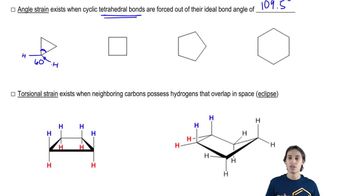
What is angle strain?

Functional Groups

Functional groups are specific groups of atoms within molecules that have characteristic properties and reactivity. In organic chemistry, recognizing functional groups like alcohols (OH), carboxylic acids (CO2H), and esters (COOCH3) is crucial for understanding the chemical behavior of compounds. Each functional group imparts distinct physical and chemical properties to the molecule.
Video consigliato:
02:36
Identifying Functional Groups

IUPAC Nomenclature

IUPAC nomenclature is a systematic method of naming organic chemical compounds as recommended by the International Union of Pure and Applied Chemistry. It provides a standardized way to name compounds based on their structure, ensuring clear communication. Understanding IUPAC rules helps in identifying the structure from a name and vice versa, which is essential for drawing line-angle formulas.
Video consigliato:
03:43
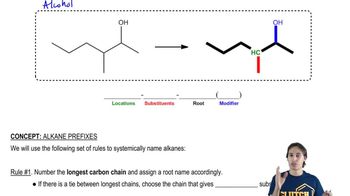
The different parts of an IUPAC name