Ch.1 - Structure and Bonding
Wade - Organic Chemistry 9th Edition
Wade9th EditionOrganic ChemistryISBN: 9780135213728Non è quello che usi tu?Cambia libro di testo
Capitolo 1, Problema 34a,b

Draw Lewis structures for
a. two compounds of formula C4H10
b. two compounds of formula C2H6O

Guida verificata passo dopo passo
1
Identify the possible structural isomers for each molecular formula. For C4H10, consider the different ways to arrange four carbon atoms and ten hydrogen atoms. For C2H6O, consider the different ways to arrange two carbon atoms, six hydrogen atoms, and one oxygen atom.
For C4H10, start by drawing the straight-chain alkane, known as butane. Arrange four carbon atoms in a linear sequence and add hydrogen atoms to satisfy the tetravalency of carbon, ensuring each carbon forms four bonds.
Next, draw the branched isomer of C4H10, known as isobutane (or methylpropane). Place three carbon atoms in a row and attach the fourth carbon as a branch to the second carbon atom. Again, add hydrogen atoms to satisfy the tetravalency of each carbon.
For C2H6O, begin by drawing the structure of ethanol. Arrange two carbon atoms in a chain, attach an OH group (hydroxyl group) to one of the carbon atoms, and add hydrogen atoms to satisfy the tetravalency of carbon.
Draw the second isomer of C2H6O, which is dimethyl ether. Place the oxygen atom between the two carbon atoms, forming an ether linkage, and add hydrogen atoms to satisfy the tetravalency of each carbon.

Risposta video verificata per un problema simile:

Questa soluzione video è stata consigliata dai nostri tutor come utile per risolvere questo problema.
Durata del video:
6m

Concetti chiave

Ecco i concetti essenziali che devi comprendere per rispondere correttamente alla domanda.

Lewis Structures

Lewis structures are diagrams that represent the bonding between atoms of a molecule and the lone pairs of electrons that may exist. They are essential for visualizing the arrangement of atoms, the distribution of electrons, and the connectivity in a molecule, which helps in predicting the molecule's shape, reactivity, and properties.
Video consigliato:
04:12
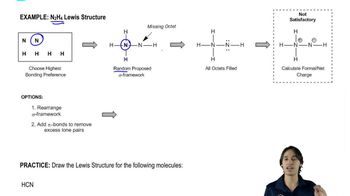
Drawing the Lewis Structure for N2H4.

Isomerism

Isomerism refers to the phenomenon where compounds with the same molecular formula have different structural arrangements. In the context of C4H10 and C2H6O, structural isomers differ in the connectivity of atoms, leading to distinct compounds with unique physical and chemical properties, such as butane and isobutane for C4H10.
Video consigliato:
06:47
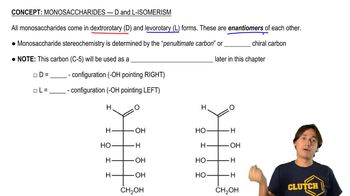
Monosaccharides - D and L Isomerism

Functional Groups

Functional groups are specific groups of atoms within molecules that are responsible for the characteristic chemical reactions of those molecules. For C2H6O, understanding functional groups like alcohols (e.g., ethanol) and ethers (e.g., dimethyl ether) is crucial, as they determine the compound's reactivity and interaction with other substances.
Video consigliato:
02:36
Identifying Functional Groups