Ch.1 - Structure and Bonding
Wade - Organic Chemistry 9th Edition
Wade9th EditionOrganic ChemistryISBN: 9780135213728Non è quello che usi tu?Cambia libro di testo
Capitolo 1, Problema 32a,b

Draw a Lewis structure for each compound. Include all nonbonding pairs of electrons.
a. CH3COCH2CHCHCOOH
b. NCCH2COCH2CHO

Guida verificata passo dopo passo
1
Step 1: Identify the total number of valence electrons for each compound. For compound (a) CH3COCH2CHCHCOOH, count the valence electrons from each atom: Carbon (C) has 4, Hydrogen (H) has 1, and Oxygen (O) has 6. For compound (b) NCCH2COCH2CHO, include Nitrogen (N) which has 5 valence electrons.
Step 2: Determine the connectivity of atoms in each compound. For compound (a), the backbone is CH3-CO-CH2-CH-CH-COOH. For compound (b), the backbone is NC-CH2-CO-CH2-CHO. This helps in arranging the atoms in a linear or branched structure.
Step 3: Draw single bonds between the atoms based on the connectivity determined in Step 2. Each single bond represents a pair of shared electrons. Use MathML to represent these bonds, for example: -.
Step 4: Distribute the remaining valence electrons to satisfy the octet rule for each atom, starting with the most electronegative atoms (usually oxygen and nitrogen). Place lone pairs where necessary, especially on oxygen and nitrogen atoms. Use MathML to represent lone pairs, for example: :.
Step 5: Check the formal charges on each atom to ensure the most stable Lewis structure. Adjust the placement of electrons if necessary to minimize formal charges, ensuring that the overall charge of the molecule is correct.

Risposta video verificata per un problema simile:

Questa soluzione video è stata consigliata dai nostri tutor come utile per risolvere questo problema.
Durata del video:
9m

Concetti chiave

Ecco i concetti essenziali che devi comprendere per rispondere correttamente alla domanda.

Lewis Structures

Lewis structures are diagrams that represent the bonding between atoms of a molecule and the lone pairs of electrons that may exist. They are essential for visualizing the arrangement of atoms, the distribution of electrons, and the connectivity within a molecule. Understanding how to draw Lewis structures involves knowing the valence electrons for each atom and applying the octet rule to ensure stability.
Video consigliato:
04:12
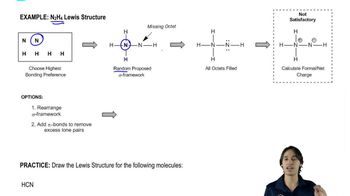
Drawing the Lewis Structure for N2H4.

Valence Electrons

Valence electrons are the outermost electrons of an atom and are crucial in forming chemical bonds. In drawing Lewis structures, it is important to account for all valence electrons to accurately depict the molecule's structure. The number of valence electrons can be determined from an element's group number in the periodic table, and they dictate how atoms will bond and interact with each other.
Video consigliato:
03:40
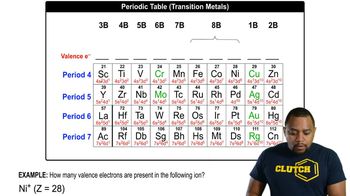
Valence Electrons of Transition Metals

Functional Groups

Functional groups are specific groups of atoms within molecules that have characteristic properties and reactivity. In organic chemistry, recognizing functional groups like carbonyl (C=O), carboxyl (COOH), and nitrile (CN) is crucial for understanding the molecule's behavior and drawing its Lewis structure. Each functional group has a typical bonding pattern that must be represented accurately in the structure.
Video consigliato:
02:36
Identifying Functional Groups