Ch.1 - Structure and Bonding
Wade - Organic Chemistry 9th Edition
Wade9th EditionOrganic ChemistryISBN: 9780135213728Non è quello che usi tu?Cambia libro di testo
Capitolo 1, Problema 29

For each compound, state whether its bonding is covalent, ionic, or a mixture of covalent and ionic.
a. NaCl
b. NaOH
c. CH3Li
d. CH2Cl2
e. NaOCH3
f. HCO2Na
g. CF4

Guida verificata passo dopo passo
1
Identify the types of elements involved in each compound. Generally, compounds formed between metals and nonmetals are ionic, while those formed between nonmetals are covalent.
For NaCl, recognize that it consists of a metal (Na) and a nonmetal (Cl), indicating ionic bonding.
For NaOH, note that it contains a metal (Na) and a polyatomic ion (OH). The bond between Na and OH is ionic, while the bond within OH is covalent.
For CH3Li, observe that it contains a metal (Li) and a nonmetal (C). This suggests a mixture of covalent (C-H bonds) and ionic (C-Li bond) bonding.
For CH2Cl2, recognize that it consists entirely of nonmetals (C, H, Cl), indicating covalent bonding.

Risposta video verificata per un problema simile:

Questa soluzione video è stata consigliata dai nostri tutor come utile per risolvere questo problema.
Durata del video:
5m

Concetti chiave

Ecco i concetti essenziali che devi comprendere per rispondere correttamente alla domanda.

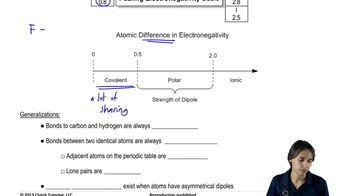
Covalent Bonding

Covalent bonding occurs when two atoms share one or more pairs of electrons, typically between nonmetals. This type of bond is characterized by the mutual sharing of electrons to achieve a full outer shell, resulting in the formation of molecules. Examples include the bonds in CH2Cl2 and CF4, where carbon shares electrons with hydrogen, chlorine, or fluorine.
Video consigliato:
11:33
Differences between ionic, polar and covalent bonds

Ionic Bonding

Ionic bonding involves the transfer of electrons from one atom to another, leading to the formation of charged ions. This bond typically occurs between metals and nonmetals, where the metal loses electrons to become a cation, and the nonmetal gains electrons to become an anion. NaCl is a classic example, where sodium donates an electron to chlorine.
Video consigliato:
11:33
Differences between ionic, polar and covalent bonds

Mixed Bonding (Covalent and Ionic)

Some compounds exhibit both covalent and ionic characteristics, often involving polyatomic ions. In such cases, covalent bonds exist within the polyatomic ion, while ionic bonds form between the ion and other atoms. For instance, in NaOH, the OH group is covalently bonded, while the bond between Na and OH is ionic.
Video consigliato:
11:33
Differences between ionic, polar and covalent bonds