Ch.1 - Structure and Bonding
Wade - Organic Chemistry 9th Edition
Wade9th EditionOrganic ChemistryISBN: 9780135213728Non è quello che usi tu?Cambia libro di testo
Capitolo 1, Problema 28

There is a small portion of the periodic table that you must know to do organic chemistry. Construct this part from ­memory, using the following steps.
a. From memory, make a list of the elements in the first two rows of the periodic table, together with their numbers of valence electrons
b. Use this list to construct the first two rows of the periodic table.
c. Organic compounds often contain sulfur, phosphorus, chlorine, bromine, and iodine. Add these elements to your ­periodic table.

Guida verificata passo dopo passo
1
Start by recalling the elements in the first row of the periodic table. These are Hydrogen (H) and Helium (He). Hydrogen has 1 valence electron, while Helium has 2 valence electrons.
Next, recall the elements in the second row of the periodic table. These are Lithium (Li), Beryllium (Be), Boron (B), Carbon (C), Nitrogen (N), Oxygen (O), Fluorine (F), and Neon (Ne). Their valence electrons are as follows: Li has 1, Be has 2, B has 3, C has 4, N has 5, O has 6, F has 7, and Ne has 8.
Using the list from steps 1 and 2, construct the first two rows of the periodic table. The first row consists of H and He, and the second row consists of Li, Be, B, C, N, O, F, and Ne.
Identify the additional elements commonly found in organic compounds: sulfur (S), phosphorus (P), chlorine (Cl), bromine (Br), and iodine (I). These elements are located in the third and fourth rows of the periodic table.
Add these elements to your constructed periodic table. Sulfur and phosphorus are in the third row, while chlorine, bromine, and iodine are in the third and fourth rows. Ensure their placement reflects their respective groups and periods.

Risposta video verificata per un problema simile:

Questa soluzione video è stata consigliata dai nostri tutor come utile per risolvere questo problema.
Durata del video:
5m

Concetti chiave

Ecco i concetti essenziali che devi comprendere per rispondere correttamente alla domanda.

Valence Electrons

Valence electrons are the outermost electrons of an atom and are crucial in determining how an element reacts chemically. In organic chemistry, understanding the number of valence electrons helps predict bonding patterns and reactivity. For example, carbon has four valence electrons, allowing it to form four covalent bonds, which is fundamental in organic molecules.
Video consigliato:
03:40
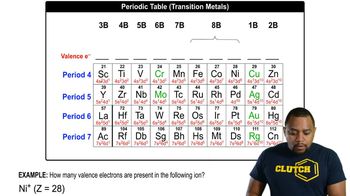
Valence Electrons of Transition Metals

Periodic Table Structure

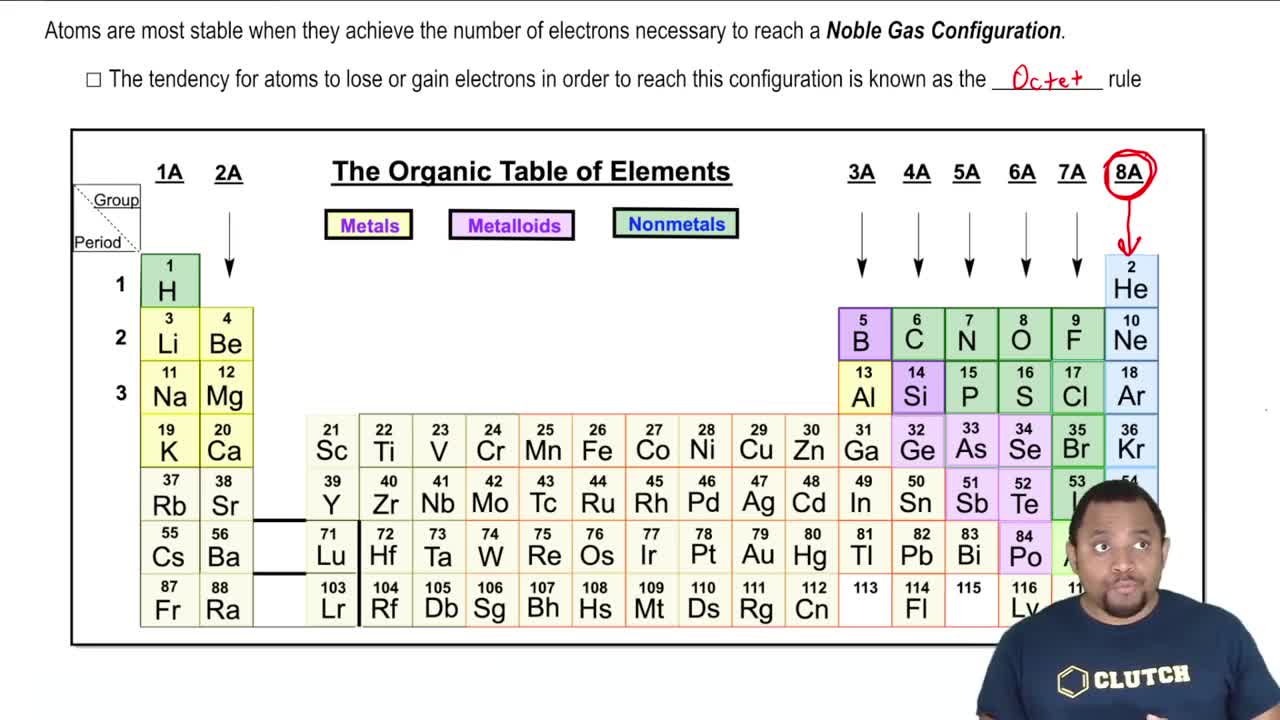
The periodic table is organized by increasing atomic number and groups elements with similar properties into columns. The first two rows, or periods, include essential elements like hydrogen, helium, lithium, beryllium, boron, carbon, nitrogen, oxygen, fluorine, and neon. Recognizing these elements and their properties is vital for understanding the basic building blocks of organic compounds.
Video consigliato:
02:24
The most important parts of the periodic table for organic chemistry

Common Elements in Organic Chemistry

Organic chemistry frequently involves elements beyond carbon and hydrogen, such as sulfur, phosphorus, chlorine, bromine, and iodine. These elements often participate in forming functional groups, which define the chemical properties and reactions of organic molecules. For instance, chlorine and bromine are halogens that can form polar covalent bonds, influencing the reactivity and solubility of organic compounds.
Video consigliato:
02:01
Introducing common solvents and other molecules in organic chemistry.