Ch.1 - Structure and Bonding
Wade - Organic Chemistry 9th Edition
Wade9th EditionOrganic ChemistryISBN: 9780135213728Non è quello che usi tu?Cambia libro di testo
Capitolo 1, Problema 31a-d

Draw a Lewis Structure for each species.
a. N2H4
b. N2H2
c. (CH3)2NH2Cl
d. CH3CN

Guida verificata passo dopo passo
1
Step 1: Understand the concept of Lewis structures. Lewis structures are diagrams that show the bonding between atoms of a molecule and the lone pairs of electrons that may exist. They help visualize the arrangement of electrons in a molecule.
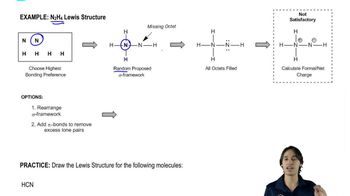
Step 2: For N2H4, start by counting the total number of valence electrons. Nitrogen (N) has 5 valence electrons and hydrogen (H) has 1 valence electron. Calculate the total: 2(N) * 5 + 4(H) * 1 = 14 valence electrons.
Step 3: For N2H2, count the total number of valence electrons. Again, nitrogen has 5 valence electrons and hydrogen has 1 valence electron. Calculate the total: 2(N) * 5 + 2(H) * 1 = 12 valence electrons.
Step 4: For (CH3)2NH2Cl, count the total number of valence electrons. Carbon (C) has 4 valence electrons, hydrogen has 1, nitrogen has 5, and chlorine (Cl) has 7. Calculate the total: 2(C) * 4 + 7(H) * 1 + 1(N) * 5 + 1(Cl) * 7 = 26 valence electrons.
Step 5: For CH3CN, count the total number of valence electrons. Carbon has 4 valence electrons, hydrogen has 1, and nitrogen has 5. Calculate the total: 2(C) * 4 + 3(H) * 1 + 1(N) * 5 = 16 valence electrons.

Risposta video verificata per un problema simile:

Questa soluzione video è stata consigliata dai nostri tutor come utile per risolvere questo problema.
Durata del video:
10m

Concetti chiave

Ecco i concetti essenziali che devi comprendere per rispondere correttamente alla domanda.

Lewis Structures

Lewis structures are diagrams that represent the bonding between atoms of a molecule and the lone pairs of electrons that may exist. They are essential for visualizing the arrangement of atoms, the distribution of electrons, and the types of bonds (single, double, or triple) in a molecule. Understanding how to draw Lewis structures helps in predicting the geometry, reactivity, and properties of the molecule.
Video consigliato:
04:12
Drawing the Lewis Structure for N2H4.

Valence Electrons

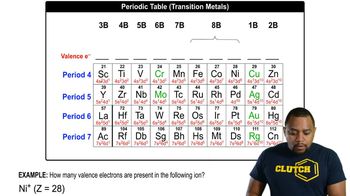
Valence electrons are the outermost electrons of an atom and are crucial in forming chemical bonds. In drawing Lewis structures, it is important to know the number of valence electrons for each atom to ensure that the structure adheres to the octet rule, where atoms tend to have eight electrons in their valence shell, or the duet rule for hydrogen, which requires two electrons.
Video consigliato:
03:40
Valence Electrons of Transition Metals

Formal Charge

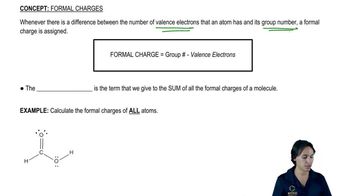
Formal charge is a concept used to determine the most stable Lewis structure for a molecule. It is calculated by assuming equal sharing of electrons in bonds and is given by the formula: Formal Charge = (Valence Electrons) - (Non-bonding Electrons) - (Bonding Electrons/2). Structures with formal charges closest to zero are generally more stable, and this concept helps in identifying the most plausible structure among possible resonance forms.
Video consigliato:
01:34
Calculating formal and net charge.