Ch.1 - Structure and Bonding
Wade - Organic Chemistry 9th Edition
Wade9th EditionOrganic ChemistryISBN: 9780135213728Non è quello che usi tu?Cambia libro di testo
Capitolo 1, Problema 52h

For each of the following compounds and ions,
1. Draw a Lewis structure.
2. Show the kinds of orbitals that overlap to form each bond.
3. Give approximate bond angles around each atom except hydrogen
h. Lewis structure of a compound showing bond formation and approximate bond angles around atoms.

Guida verificata passo dopo passo
1
Identify the compound as furan-2(5H)-one, which is a five-membered lactone ring containing an oxygen atom and a carbonyl group.
Draw the Lewis structure by arranging the atoms in a ring with alternating single and double bonds, ensuring that each atom satisfies the octet rule. The oxygen in the carbonyl group will have a double bond with the adjacent carbon.
Determine the types of orbitals involved in bonding: the C-O single bond involves sp3 hybridized orbitals from carbon and oxygen, while the C=O double bond involves sp2 hybridized orbitals from carbon and oxygen.
Estimate the bond angles: around the sp2 hybridized carbon in the carbonyl group, the bond angles are approximately 120 degrees, while around the sp3 hybridized carbon, the bond angles are approximately 109.5 degrees.
Consider resonance structures: the double bond in the ring can shift, creating resonance structures that contribute to the stability of the molecule.

Risposta video verificata per un problema simile:

Questa soluzione video è stata consigliata dai nostri tutor come utile per risolvere questo problema.
Durata del video:
11m

Concetti chiave

Ecco i concetti essenziali che devi comprendere per rispondere correttamente alla domanda.

Lewis Structures

Lewis structures are diagrams that represent the bonding between atoms of a molecule and the lone pairs of electrons that may exist. They are essential for visualizing the arrangement of atoms, the distribution of electrons, and the types of bonds (single, double, or triple) present in a molecule. Understanding Lewis structures helps in predicting the geometry and reactivity of the molecule.
Video consigliato:
04:12
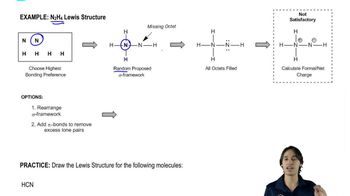
Drawing the Lewis Structure for N2H4.

Orbital Overlap and Bond Formation

Orbital overlap is a concept that explains how covalent bonds form when atomic orbitals overlap, allowing electrons to be shared between atoms. The type of orbitals involved (s, p, d) determines the bond's characteristics. For example, sigma (σ) bonds result from head-on overlap, while pi (π) bonds result from side-on overlap. Recognizing the types of orbitals involved is crucial for understanding molecular geometry and bond strength.
Video consigliato:
06:00
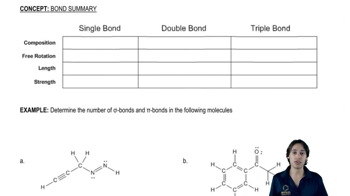
Single bonds, double bonds, and triple bonds.

Bond Angles and Molecular Geometry

Bond angles are the angles between adjacent bonds at an atom, which are determined by the molecule's geometry. VSEPR (Valence Shell Electron Pair Repulsion) theory is often used to predict these angles, as electron pairs around a central atom will arrange themselves to minimize repulsion. Understanding bond angles is important for predicting the shape and reactivity of molecules, as well as their physical properties.
Video consigliato:
07:44
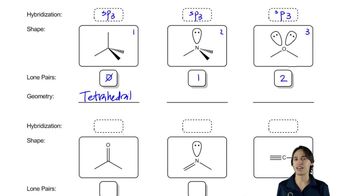
Molecular Geometry Explained.