
Ch.1 - Structure and Bonding
Wade - Organic Chemistry 9th Edition
Wade9th EditionOrganic ChemistryISBN: 9780135213728Non è quello che usi tu?Cambia libro di testo
Capitolo 1, Problema 52g

For each of the following compounds and ions,
1. Draw a Lewis structure.
2. Show the kinds of orbitals that overlap to form each bond.
3. Give approximate bond angles around each atom except hydrogen.
g. Lewis structure of acetic acid showing carbon, oxygen, and hydrogen atoms with bonds and lone pairs.

Guida verificata passo dopo passo
1
Draw the Lewis structure for acetic acid (CH3COOH). Start by arranging the atoms: the central carbon atom is bonded to a methyl group (CH3), a carbonyl oxygen (O), and a hydroxyl group (OH).
Identify the types of orbitals involved in bonding. The carbon-carbon and carbon-oxygen single bonds are formed by the overlap of sp3 hybrid orbitals from carbon with the s orbitals of hydrogen and the sp3 hybrid orbitals of oxygen. The carbon-oxygen double bond involves sp2 hybrid orbitals from carbon and oxygen, with a pi bond formed by the overlap of unhybridized p orbitals.
Determine the approximate bond angles. Around the central carbon atom, the bond angles are approximately 120 degrees due to the sp2 hybridization, which gives a trigonal planar geometry. Around the oxygen in the hydroxyl group, the bond angle is approximately 104.5 degrees due to the bent shape caused by the two lone pairs on oxygen.
Consider the resonance structures. Although acetic acid primarily exists in the form shown, resonance can occur between the carbonyl oxygen and the hydroxyl group, affecting the electron distribution.
Review the formal charges. Ensure that all atoms have a formal charge of zero, which is typical for stable organic molecules like acetic acid. This involves checking that each atom has the appropriate number of bonds and lone pairs to satisfy the octet rule.

Risposta video verificata per un problema simile:

Questa soluzione video è stata consigliata dai nostri tutor come utile per risolvere questo problema.
Durata del video:
8m

Concetti chiave

Ecco i concetti essenziali che devi comprendere per rispondere correttamente alla domanda.

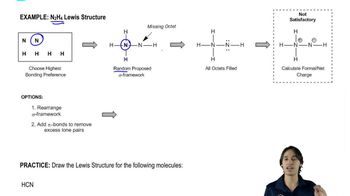
Lewis Structures

Lewis structures are diagrams that represent the bonding between atoms in a molecule and the lone pairs of electrons that may exist. They use dots to represent valence electrons and lines to represent bonds between atoms. Understanding how to draw Lewis structures is essential for visualizing molecular geometry and predicting reactivity.
Video consigliato:
04:12
Drawing the Lewis Structure for N2H4.

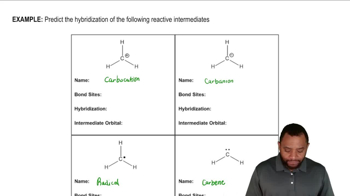
Orbital Hybridization

Orbital hybridization is the concept of mixing atomic orbitals to form new hybrid orbitals that can accommodate the bonding requirements of atoms in a molecule. This process helps explain the geometry of molecular structures, as different types of hybridization (such as sp, sp2, and sp3) correspond to specific bond angles and shapes.
Video consigliato:
04:58
Bond sites, hybridization, and intermediate orbitals

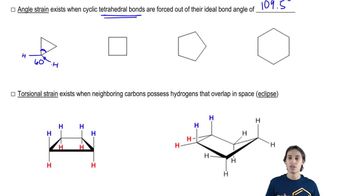
Bond Angles

Bond angles are the angles formed between adjacent bonds in a molecule, which are influenced by the arrangement of electron pairs around a central atom. These angles are critical for determining the three-dimensional shape of a molecule, which can affect its physical and chemical properties. Common bond angles include 109.5° for tetrahedral, 120° for trigonal planar, and 180° for linear geometries.
Video consigliato:
02:46
What is angle strain?
Pratica correlata
Domanda del libro di testo

For each of the following compounds and ions,

1. Draw a Lewis structure.

2. Show the kinds of orbitals that overlap to form each bond.

3. Give approximate bond angles around each atom except hydrogen.

d. CH3–CH=CH2

e. HC≡C–CHO

f. H2N–CH2–CN

1255
views
Domanda del libro di testo

For each of the following compounds and ions,

1. Draw a Lewis structure.

2. Show the kinds of orbitals that overlap to form each bond.

3. Give approximate bond angles around each atom except hydrogen

h.

655
views
Domanda del libro di testo

Predict the hybridization and geometry of the carbon and nitrogen atoms in the following molecules and ions. (Hint: Resonance.)

a.

b.

c.

2600
views
Domanda del libro di testo

For each of the following compounds and ions,

1. Draw a Lewis structure.

2. Show the kinds of orbitals that overlap to form each bond.

3. Give approximate bond angles around each atom except hydrogen.

b. [CH2OH]+

1040
views
Domanda del libro di testo

For each of the following compounds and ions,

1. Draw a Lewis structure.

2. Show the kinds of orbitals that overlap to form each bond.

3. Give approximate bond angles around each atom except hydrogen.

c. CH2=N–CH3

911
views
Domanda del libro di testo

In most amines, the nitrogen atom is sp3 hybridized, with a pyramidal structure and bond angles close to 109°. In urea, both nitrogen atoms are found to be planar, with bond angles close to 120°. Explain this surprising finding. (Hint: Consider resonance forms and the overlap needed in them.)

2722
views