Ch.1 - Structure and Bonding
Wade - Organic Chemistry 9th Edition
Wade9th EditionOrganic ChemistryISBN: 9780135213728Non è quello che usi tu?Cambia libro di testo
Capitolo 1, Problema 53

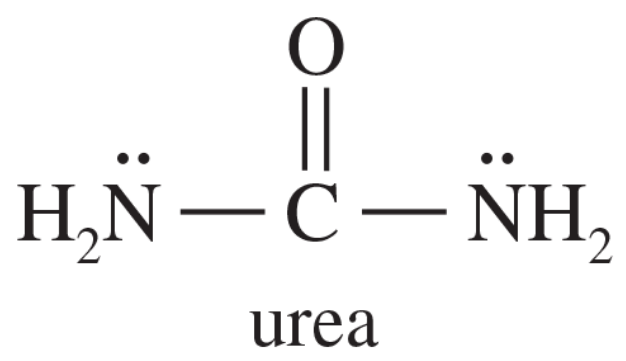
In most amines, the nitrogen atom is sp3 hybridized, with a pyramidal structure and bond angles close to 109°. In urea, both nitrogen atoms are found to be planar, with bond angles close to 120°. Explain this surprising finding. (Hint: Consider resonance forms and the overlap needed in them.)

Guida verificata passo dopo passo
1
Identify the structure of urea: Urea has the formula (NH2)2CO, with two nitrogen atoms bonded to a central carbonyl carbon.
Recognize the typical hybridization of nitrogen in amines: In most amines, nitrogen is sp3 hybridized, leading to a pyramidal shape with bond angles around 109°.
Consider the resonance in urea: Urea can exhibit resonance, where the lone pair on the nitrogen can delocalize and form a double bond with the carbon, while the double bond between carbon and oxygen can shift to give oxygen a negative charge.
Analyze the effect of resonance on hybridization: The resonance form where nitrogen forms a double bond with carbon requires the nitrogen to be sp2 hybridized, which results in a planar structure with bond angles close to 120°.
Conclude the reason for planarity: The ability of nitrogen's lone pair to participate in resonance with the carbonyl group stabilizes the planar structure, making the sp2 hybridization more favorable in urea compared to the typical sp3 hybridization in amines.

Risposta video verificata per un problema simile:

Questa soluzione video è stata consigliata dai nostri tutor come utile per risolvere questo problema.
Durata del video:
3m

Concetti chiave

Ecco i concetti essenziali che devi comprendere per rispondere correttamente alla domanda.

Hybridization

Hybridization is the concept that describes the mixing of atomic orbitals to form new hybrid orbitals, which can explain the geometry of molecular structures. In most amines, nitrogen is sp³ hybridized, resulting in a tetrahedral arrangement with bond angles around 109°. However, in urea, the nitrogen atoms are involved in resonance, leading to a different hybridization state.
Video consigliato:
10:43
Using bond sites to predict hybridization

Resonance

Resonance is a phenomenon in which a molecule can be represented by two or more valid Lewis structures, known as resonance forms. In urea, the resonance between the nitrogen and carbonyl oxygen allows for delocalization of electrons, which stabilizes the molecule and results in a planar structure with bond angles close to 120°, deviating from the typical sp³ hybridization of amines.
Video consigliato:
03:04
Drawing Resonance Structures

Planarity and Bond Angles

Planarity in molecular structures refers to the arrangement of atoms in a single plane, which affects the bond angles between them. In urea, the presence of resonance and the sp² hybridization of the nitrogen atoms lead to a planar configuration, resulting in bond angles of approximately 120°. This contrasts with the pyramidal shape of typical amines, where bond angles are closer to 109°.
Video consigliato:
02:46
What is angle strain?