Ch.10 - Structure and Synthesis of Alcohols
Wade - Organic Chemistry 9th Edition
Wade9th EditionOrganic ChemistryISBN: 9780135213728Non è quello che usi tu?Cambia libro di testo
Capitolo 10, Problema 9

A nitro group (–NO2) effectively stabilizes a negative charge on an adjacent carbon atom through resonance:

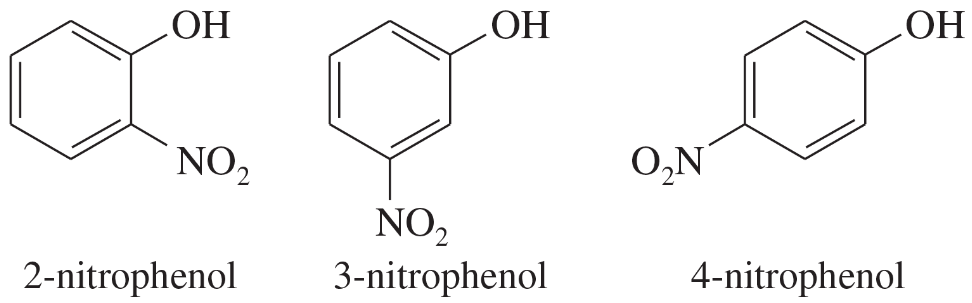
Two of the following nitrophenols are much more acidic than phenol itself. The third compound is only slightly more acidic than phenol. Use resonance structures of the appropriate phenoxide ions to show why two of these anions should be unusually stable.

Guida verificata passo dopo passo
1
Identify the nitrophenols: 2-nitrophenol, 3-nitrophenol, and 4-nitrophenol. These compounds have a nitro group (¬NO2) attached to the benzene ring at different positions relative to the hydroxyl group (¬OH).
Understand the effect of the nitro group on acidity: The nitro group is an electron-withdrawing group that can stabilize a negative charge through resonance. This stabilization increases the acidity of the phenol by making the phenoxide ion more stable.
Analyze the resonance structures: For 2-nitrophenol and 4-nitrophenol, the nitro group is positioned such that it can participate in resonance with the phenoxide ion, effectively stabilizing the negative charge. Draw resonance structures showing the delocalization of electrons from the phenoxide ion to the nitro group.
Compare the stability of the phenoxide ions: The resonance structures for 2-nitrophenol and 4-nitrophenol show significant stabilization of the negative charge due to the nitro group. In contrast, 3-nitrophenol does not have the nitro group in a position that allows effective resonance stabilization, making it only slightly more acidic than phenol.
Conclude which nitrophenols are more acidic: Based on the resonance stabilization, 2-nitrophenol and 4-nitrophenol are much more acidic than phenol itself, while 3-nitrophenol is only slightly more acidic due to less effective resonance stabilization.

Risposta video verificata per un problema simile:

Questa soluzione video è stata consigliata dai nostri tutor come utile per risolvere questo problema.
Durata del video:
8m

Concetti chiave

Ecco i concetti essenziali che devi comprendere per rispondere correttamente alla domanda.

Resonance

Resonance is a concept in organic chemistry that describes the delocalization of electrons in molecules where the bonding cannot be expressed by a single Lewis structure. Instead, multiple structures, known as resonance structures, are used to represent the molecule's electron distribution. This delocalization stabilizes the molecule, as seen in nitrophenols, where the negative charge can be spread over multiple atoms.
Video consigliato:
03:04
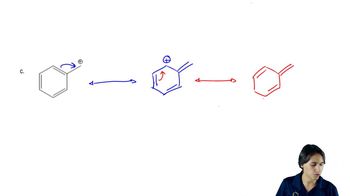
Drawing Resonance Structures

Acidity and Conjugate Bases

Acidity in organic compounds is often determined by the stability of their conjugate bases. A more stable conjugate base corresponds to a stronger acid. In the case of nitrophenols, the presence of the nitro group enhances the stability of the phenoxide ion through resonance, making the compound more acidic compared to phenol, which lacks such stabilization.
Video consigliato:
02:11
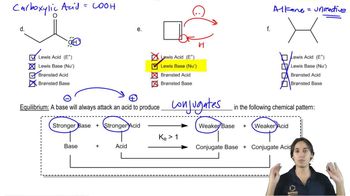
Equilibrium constant and conjugates.

Electronegative Substituents

Electronegative substituents, like nitro groups, can significantly influence the acidity of organic compounds. They stabilize negative charges through resonance or inductive effects, thereby increasing acidity. In nitrophenols, the nitro group withdraws electron density, facilitating the stabilization of the phenoxide ion and enhancing the overall acidity of the compound.
Video consigliato:
1:47
Electronegativity
Pratica correlata